Charging cables
WARNING!
Danger due to charging cables lying around.
This can result in severe personal injury and damage to property. Personnel can get
caught or trip on unplugged, loose cables
▶
Lay charging cables so that no one can trip over them or get caught on them.
WARNING!
Danger if the active charging process is interrupted by disconnecting the charging
plug.
This can result in severe personal injury and damage to property. The resulting sparks
can ignite the charging gases that form during charging and cause a fire or explosion
▶
When charging is complete, wind up the charging cables or place them on the cable
holder, if available.
Correct routing of
the mains/char-
ging cables
CAUTION!
Danger due to overheating as a result of incorrectly laid mains/charging cables.
Risk of damage to the components.
▶
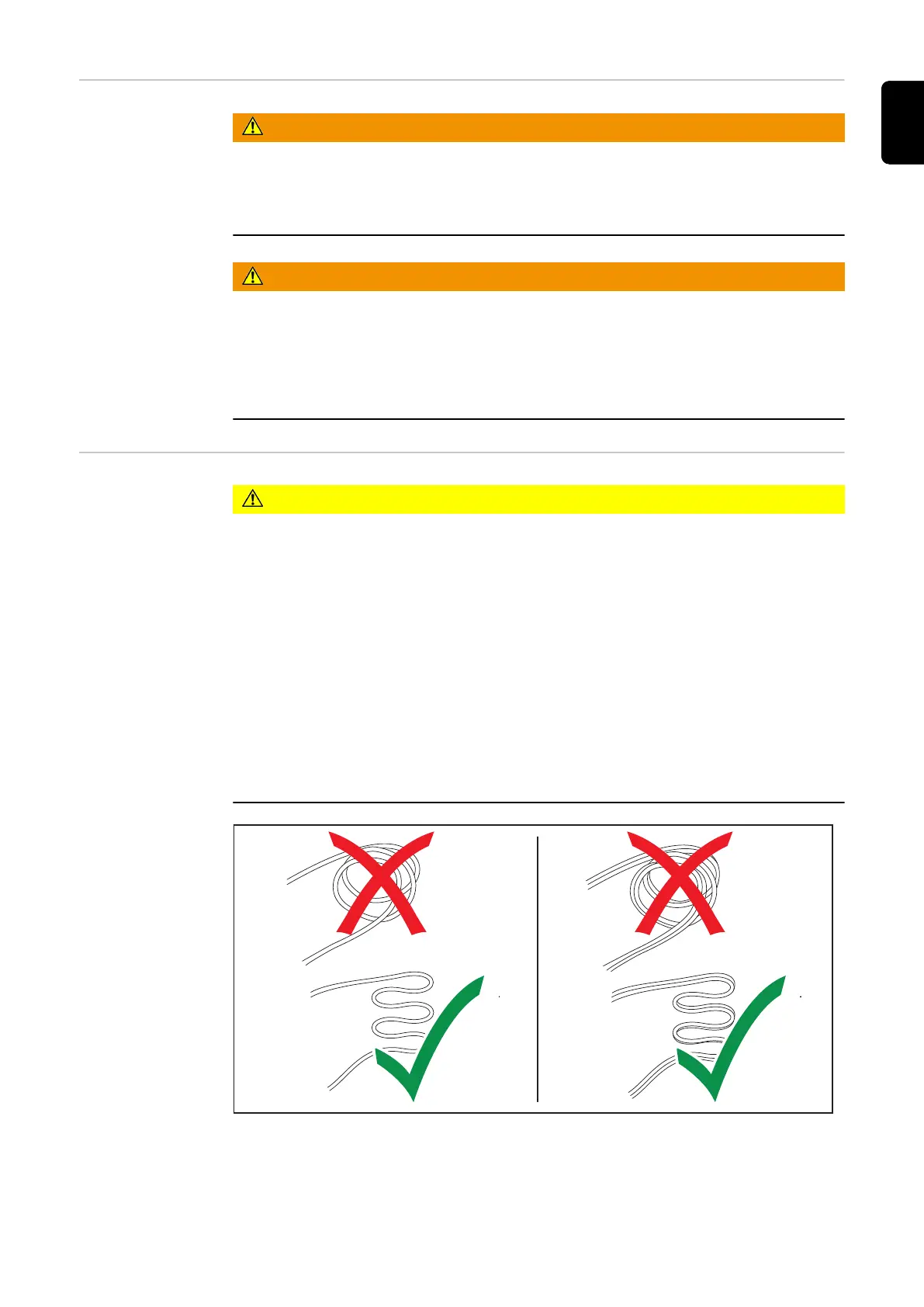
Lay the mains/charging cable without a loop.
▶
Do not cover the mains/charging cable.
▶
Charging cables longer than 5 m (16 ft. 4.85 in.) must be laid individually (no bund-
ling).
▶
Charging cables longer than 5 m (16 ft. 4.85 in.) can have an increased surface tem-
perature (be aware of hot surfaces).
▶
In the following cases, pay special attention that the surface temperature of the char-
ging cables does not exceed 80 °C (176 °F):
- Ambient temperature is 30 °C (86 °F) or more
- Cross-section of the charging cable is 95 mm
2
or more
- Length of the charging cable is 5 m (16 ft. 4.85 in.) or more
▶
The mains/charging cable may only be replaced by a qualified electrician.
13
EN-US




 To Next Page