2. SYSTEM MENU
2-3
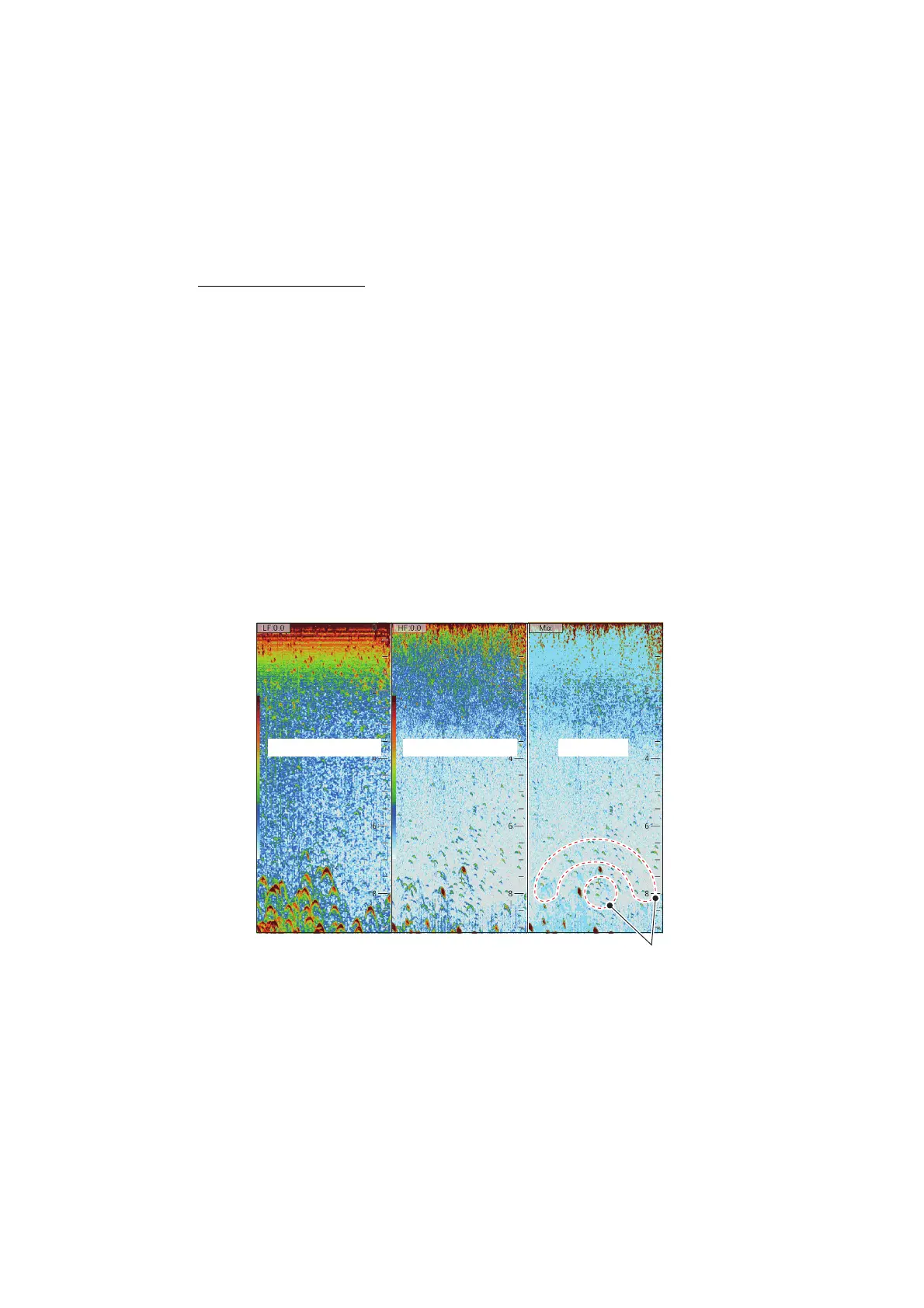
About the mix display:
The mix display compares echo intensity between low and high frequencies, and dis-
plays echoes from tiny fish in discriminative colors. This is done by utilizing the fact
that tiny fish return a stronger echo against a high frequency rather than a low frequen-
cy. It works as follows.
• If a high frequency echo is stronger than the corresponding echo on the low fre-
quency, the high frequency echo is displayed.
• If the low frequency echo is stronger than or equal to the high frequency echo, it is
less likely to be a tiny fish and therefore is displayed in blue.
• If the echoes on both frequencies have the intensity corresponding to reddish-
brown or red, they are displayed in reddish brown or red. This is necessary to dis-
play the zero line and bottom in reddish-brown or red.
• In other words, the echoes displayed in orange to light-blue are considered to be
tiny fish such as whitebait.
The meaning for each abbreviation is shown below.
LF: Low frequency LE: Low frequency of external fish finder
HF: High frequency HE: High frequency of external fish finder
LZm: Low frequency zoom LT: Low frequency of telesounder
HZm: High frequency zoom HT: High frequency of telesounder
MIX: Mix display
HF1 and HF2 show the same display. Gain can be adjusted independently for each dis-
play.
High frequency Low frequency Mix
These echoes are
likely to be small fish.


 To Next Page