52 6LE005550A
Function of the Energy trip unit
3.3 Measurement function
3.3.8
Measuring total harmonic
distortion (THD)
The Energy trip unit calculates the total harmonic distortion levels from the real-time
current and voltage measurements (every second).
These calculations are performed up to rank 31 harmonics.
The total harmonic distortion levels are energy distribution quality indicators. The
THDi is used to determine the current wave deformation level. The THDU or THDV
is used to determine the voltage wave deformation level.
Total harmonic distortion THD of current THDi
The current THD is the percentage of the root-mean-square value of current
harmonics of a rank above one, compared to the root-mean-square value of the
harmonic current of rank one.
As the level is calculated in relation to the fundamental, its value can exceed 100%.
Calculation formula symbol Definition
Rank n root-mean-square harmonic component for the
current of pole p
The THDi or, in other words, deformation rate of the current wave is caused by
receiver non-linearity, which produces non-sinusoidal current waveforms. Therefore
the THDi enables potential polluter receivers in energy distribution to be identified.
A THDi < 10% shows low pollution which is generally acceptable.
A THDi up to 50% indicates risky levels of pollution (risk of overheating, etc.).
A THDi above 50% is a high harmonics level and may result in serious degradation,
dangerous overheating and risk of malfunctions if the installation has not been
designed correctly.
Electrical variable Symbol
Version
3P
Version
4P
Panel
display
Modbus
HTP610H
tool
Maximum reactive power
per phase
Max Q1 Dmd,
Max Q2 Dmd,
Max Q3 Dmd
– X X X X
Maximum total reactive
power
Max Qtot Dmd
X X X X X
Maximum apparent
power per phase
Max S1 Dmd,
Max S2 Dmd,
Max S3 Dmd
– X X X X
Maximum total apparent
power
Max Stot DSmd
X X X X X
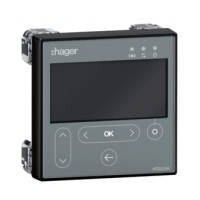
The type of integration interval and the length of interval T can be configured on the
HTD210H display and the HTP610H configuration tool (see paragraph 3.3.10).
Note
The Qtot Dmd, Stot Dmd, Max Q1 Dmd, Max Q2 Dmd, Max Q3 Dmd, Max Qtot
Dmd and Max Stot Dmd values depend on the arithmetic or vector addition
convention for reactive and apparent power (see §3.3.10 – Setting the reactive
and apparent power calculation convention).


 To Next Page