Hex ezCAN for CAN-bus-equipped Motorcycles
_________________________________________________________________________________________________
_________________________________________________________________________________________________
© Hex Innovate (UK) Ltd. Page 7 of 60 ezCAN 2408.x
low may trip power circuits for no good reason (this is known as nuisance
tripping).
The ezCAN features software amperage limits that act in the same way as
normal fuses. These ‘software fuses’ are based on the accumulated
energy principle. This means they take the severity of an over-current
condition into account and act accordingly. In practice, this means they
will not trip in the first fraction of a second in which an amperage limit has
been exceeded, but will act on the continuing energy of the event. This
means the ezCAN can intelligently handle small current spikes without
nuisance tripping.
If a circuit draws more than the amount of current you specify, the ezCAN
will cut the power supply to that circuit. To reset a circuit that has ‘tripped’
in this way, cycle the ignition (switch the motorcycle’s ignition switch OFF,
then switch it back ON).
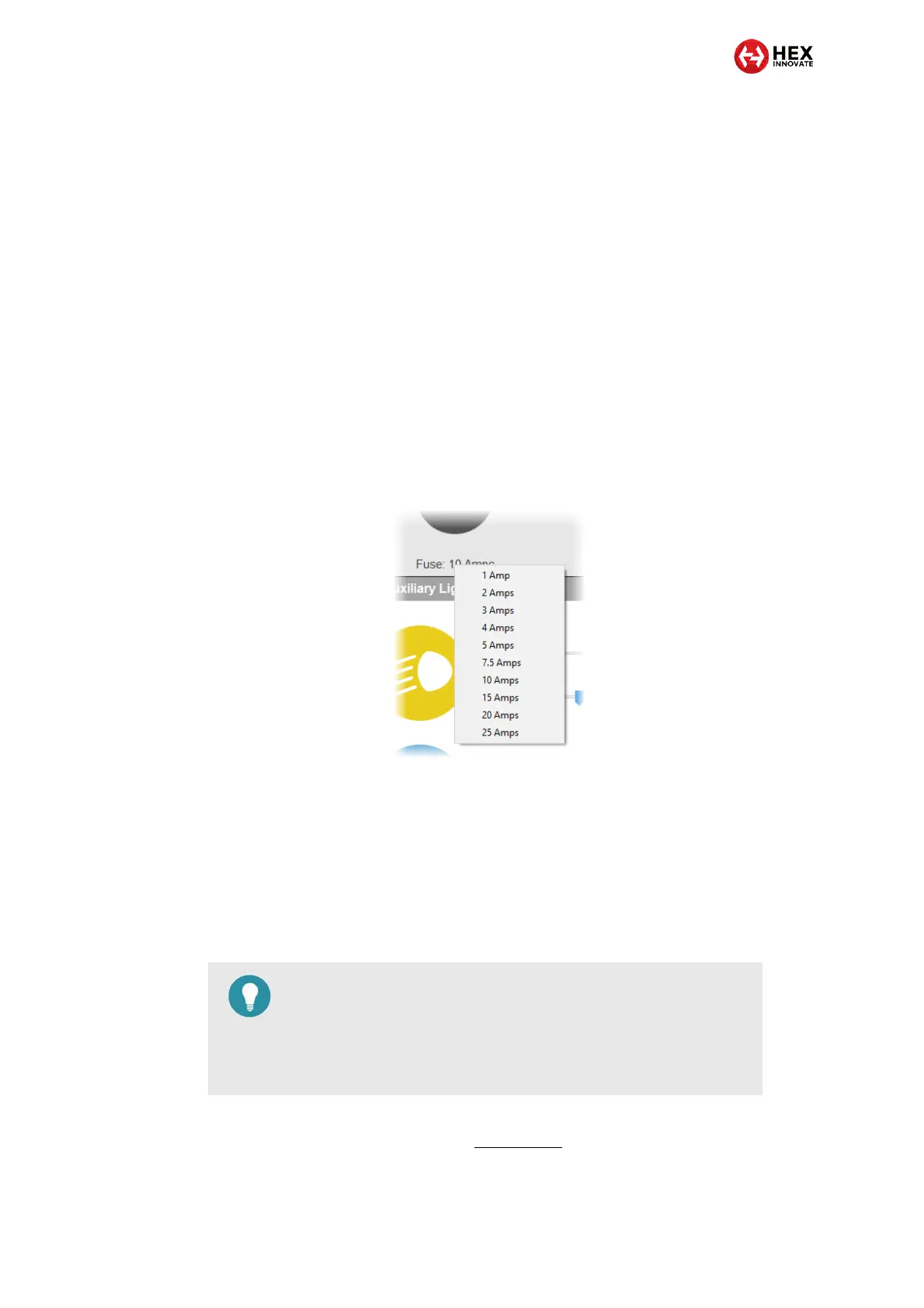
Any of the software fuses can be set to a trip point between 1 and 25
Amps (below).
Calculate the safe cut-off amperage limit for each power circuit by doing
the steps that follow:
1. Find out how much continuous current (in Amps) your accessory
uses at full power (value X).
2. Calculate the total amperage limit (value I) for the circuit by adding
a 30% margin to value X, using this formula:
3. Assign the closest software fuse setting above value I to the
circuit, using the procedure shown here.
As a typical example, you might want to connect a
run/brake light with a maximum current draw of 1.8 Amps
TIP
For larger electrical loads, it may be advisable to use a
lower margin.
If you are using a margin lower than 30%, and a power
circuit ‘trips’ repeatedly, increase the margin.


 To Next Page