General Information
1-10
become distorted after the initial
installation and removal. Discard and
replace self-locking fasteners after
removing them. Do not replace self-
locking fasteners with standard
fasteners.
Washers
The two basic types of washers are flat
washers and lock washers. Flat washers
are simple discs with a hole to fit a
screw or bolt. Lock washers are used to
prevent a fastener from working loose.
Washers can be used as spacers and
seals, or can help distribute fastener
load and prevent the fastener from
damaging the component. As with
fasteners, when replacing washers
make sure the replacement washers are
of the same design and quality.
Cotter Pins
A cotter pin is a split metal pin inserted
into a hole or slot to prevent a fastener
from loosening. In certain applications,
such as the rear axle on an UTV or
motorcycle, the fastener must be
secured in this way. For these
applications, a cotter pin and castellated
(slotted) nut is used. To use a cotter pin,
first make sure the diameter is correct
for the hole in the fastener. After
correctly tightening the fastener and
aligning the holes, insert the cotter pin
through the hole and bend the ends
over the fastener, Unless instructed to
do so, never loosen a tightened fastener
to align the holes. If the holes do not
align, tighten the fastener enough to
achieve alignment. Cotter pins are
available in various diameters and
lengths. Measure the length from the
bottom of the head to the tip of the
shortest pin.
Snap Rings and E-clips
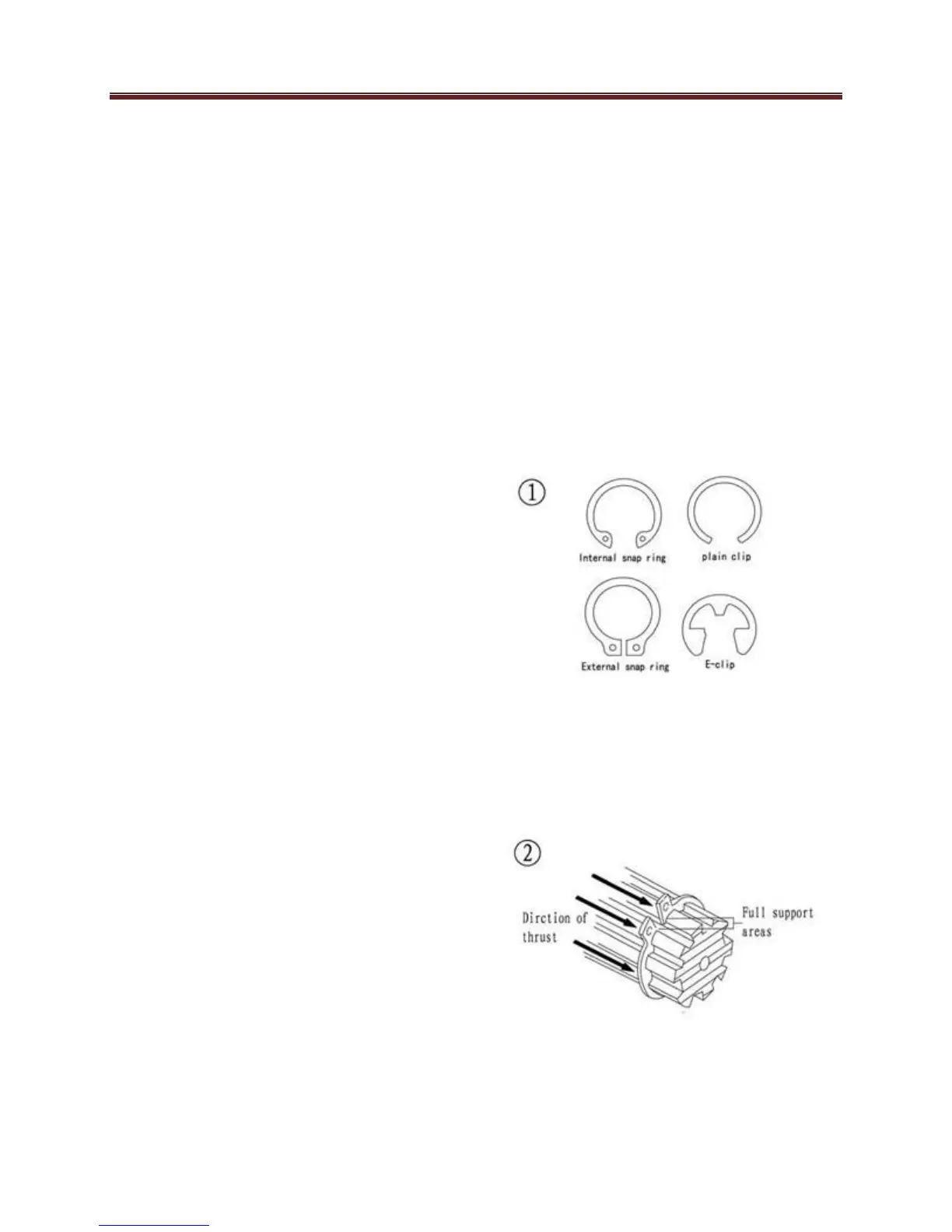
Snap rings (Figure 1) are circular-
shaped metal retaining clips. External
type snap rings are used to retain items
on shafts. Internal type snap rings
secure parts within housing bores. In
some applications, in addition to
securing the component(s), snap rings
of varying thicknesses also determine
endplay. These are usually called
selective snap rings.
The two basic types of snap rings are
machined and stamped snap rings.
Machined snap rings (Figure 2) can be
installed in either direction, because
both faces have sharp edges.
Stamped snap rings (Figure 3) are
manufactured with a sharp and a round
edge. When installing a stamped snap



 To Next Page