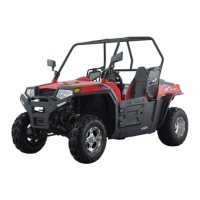
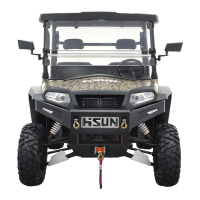
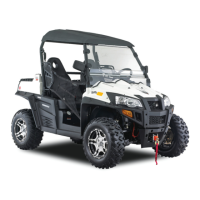
General Information
1-28
circuit and measures how difficult it is to
push the current through the circuit. An
ohmmeter, although useful, is not
always a good indicator of a circuit’s
actual ability under operating conditions.
This is because of the low voltage (6-9
volts) the meter uses to test the circuit.
The voltage in an ignition coil secondary
winding can be several thousand volts.
Such high voltage can cause the coil to
malfunction, even though it tests
acceptable during a resistance test.
Resistance generally Increases with
temperature. Perform all testing with the
component or circuit at room
temperature. Resistance tests
performed at high temperatures may
indicate high resistance readings and
cause unnecessary replacement of a
component.
Amperage
Amperage is the unit of measurement
for the amount of current within a circuit.
Current is the actual flow of electricity.
The higher the current, the more work
can be performed up to a given point. If
the current flow exceeds the circuit, it
will damage the system.
Basic Service Methods
Most of the procedures in this manual
are straightforward and can be
performed by anyone reasonably
competent with tools. However, consider
personal capabilities carefully before
attempting any operation involving major
disassembly.
1. Front, in this manual, riders to the
front of the UTV, The front of any
component is the end closest to the
front the UTV. The left and right
sides refer to the position of the parts
as viewed by the rider sitting on the
seat facing forward.
2. Whenever servicing an engine or
suspension component, secure the
UTV in a safe manner.
3. Tag all similar parts for location and
mark all mating parts for position.
Record the number and thickness of
any shims when removing them.
Identify parts by placing them in
sealed and labeled plastic sandwich
bags.
4. Tag disconnected wires and
connectors with masking tape and a
marking pen. Do not rely on memory
alone.
5. Protect finished surfaces from
physical damage or corrosion. Keep
gasoline and other chemicals off
painted surfaces.
6. Use penetrating oil on frozen or tight
bolts. Avoid using heat where
possible. Heat can warp, melt or
affect the temper of parts. Heat also
damages the finish of paint and
plastics.
7. When a part is a press fit or requires
a special tool to remove, the
information or type of tool is
identified in the text. Otherwise, if a
part is difficult to remove or install,
determine the cause before
proceeding.


 To Next Page