General Information
1-30
21. Use grease to hold small parts in
place if they tend to fall out during
assembly. Do not apply grease to
electrical or brake components.
Removing Frozen
Fasteners
If a fastener cannot be removed, several
methods may be used to loosen it. First,
apply a penetrating fluid. Apply it
liberally and let it penetrate for 10-15
minutes. Rap the fastener several times
with a small hammer. Do not hit it hard
enough to cause damage. Reapply the
penetrating fluid if necessary. For frozen
screws, apply penetrating fluid as
described, the insert a screwdriver in the
slot and rap the top of the screwdriver
with a hammer. This loosens the rust so
the screw can be removed in the normal
way. If the screw head is too damaged
to use this method, grip the head with
locking pliers and twist the screw out.
Avoid applying heat unless specifically
instructed. Heat may melt, warp or
remove the temper from parts.
Removing Broken
Fasteners
If the head breaks off a screw or bolt,
several methods are available for
removing the remaining portion. If a
large portion of the remainder projects
out, try gripping it with locking pliers. If
the projecting portion is too small, file it
to fit a wrench or cut a slot in it to fit a
screwdriver.
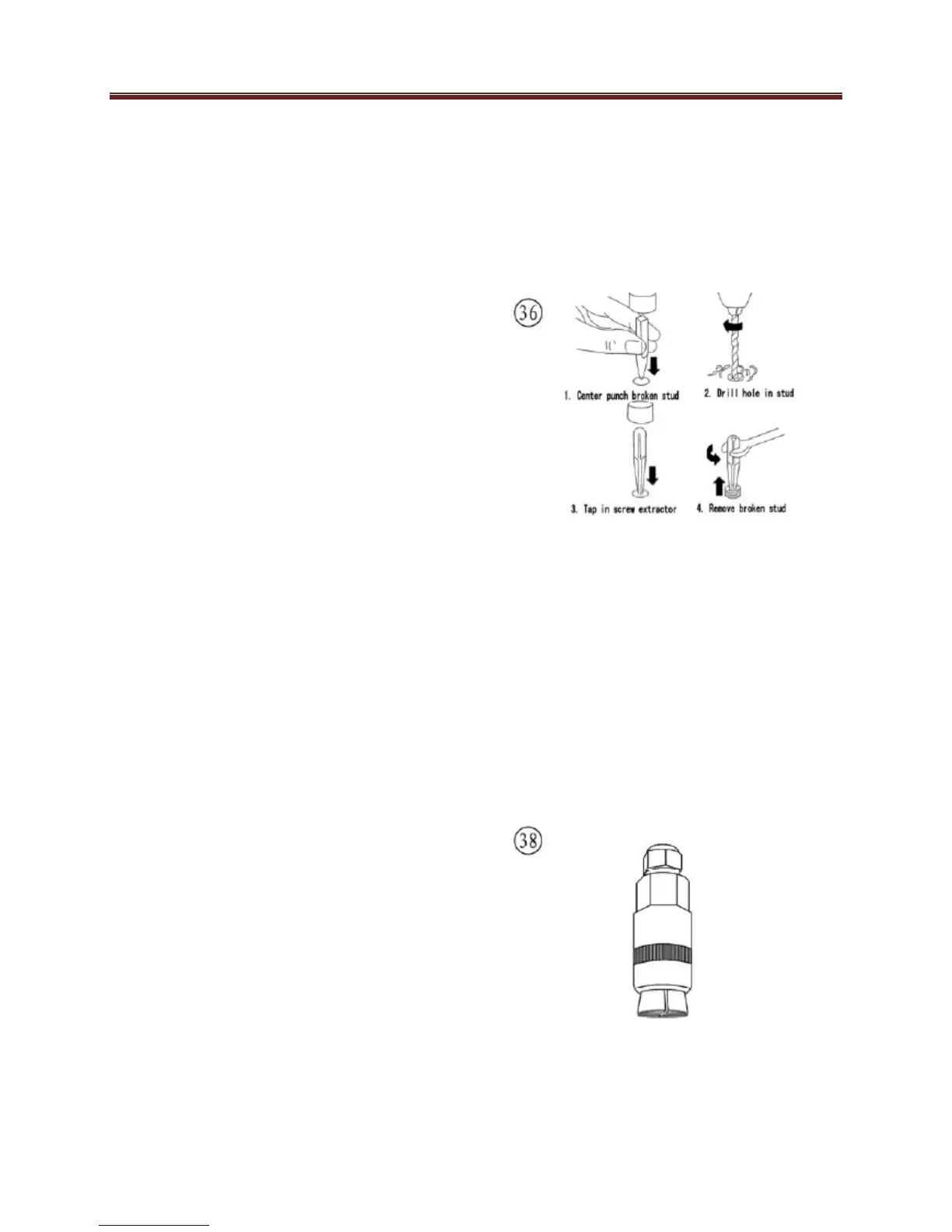
If the head breaks off flush, use a screw
extractor. To do this, center punch the
exact center of the remaining portion of
the screw or bolt. Drill a small hole in the
screw and tap the extractor into the
hole. Back the screw out with a wrench
on the extractor (Figure 36)
Stud
Removal/Installation
A stud removal tool (Figure 38) is
available from most tool suppliers. This
tool makes the removal and installation
of studs easier. If one is not available,
thread two nuts onto the stud and
tighten them against each other.
Remove the stud by turning the lower
nut (Figure 39).



 To Next Page