2.11
STEP 2 - SET FEED FORCE LIMIT
The Feed Force Value was originally developed as a means to limit maximum feed force, to prevent crooked cuts, espe-
cially in wide materials. While it is possible to set the Feed Force Limit low enough that a dull blade would just stall and
rub against the work piece, this may result in sluggish feeding.
A more practical approach is to regard the Feed Force Value as a regulator that adjusts how much the Feed Rate re-
sponds to work piece resistance.
A 0% setting results in extreme slowing of the Reed Rate, and a 100% setting results in a limited, but perceptible slowing
of Feed Rate, as resistance is encountered.
At Step 2, simply set the Feed Force pointer to the icon for the type of work piece shape being cut (H-Beam, tube, round
solid, square solid).
Proceed through steps 3, 4, and 5 (see following pages) to determine and set the optimum Feed Rate.
EXAMPLE: When cutting a solid that is ½ of machine capacity using the graph, locate 50% on the horizontal line and
travel upwards to the plotted line and then travel directly across to the vertical FF Setting line. The point that you have ar-
rived at shows a setting of 40% for a piece 50% of capacity.
STEP 3 - DETERMINE OPTIMUM BLADE PITCH - TEETH PER INCH (T.P.I.)
Selecting a blade with proper tooth pitch is important in order to achieve optimal cutting rates and good blade life.
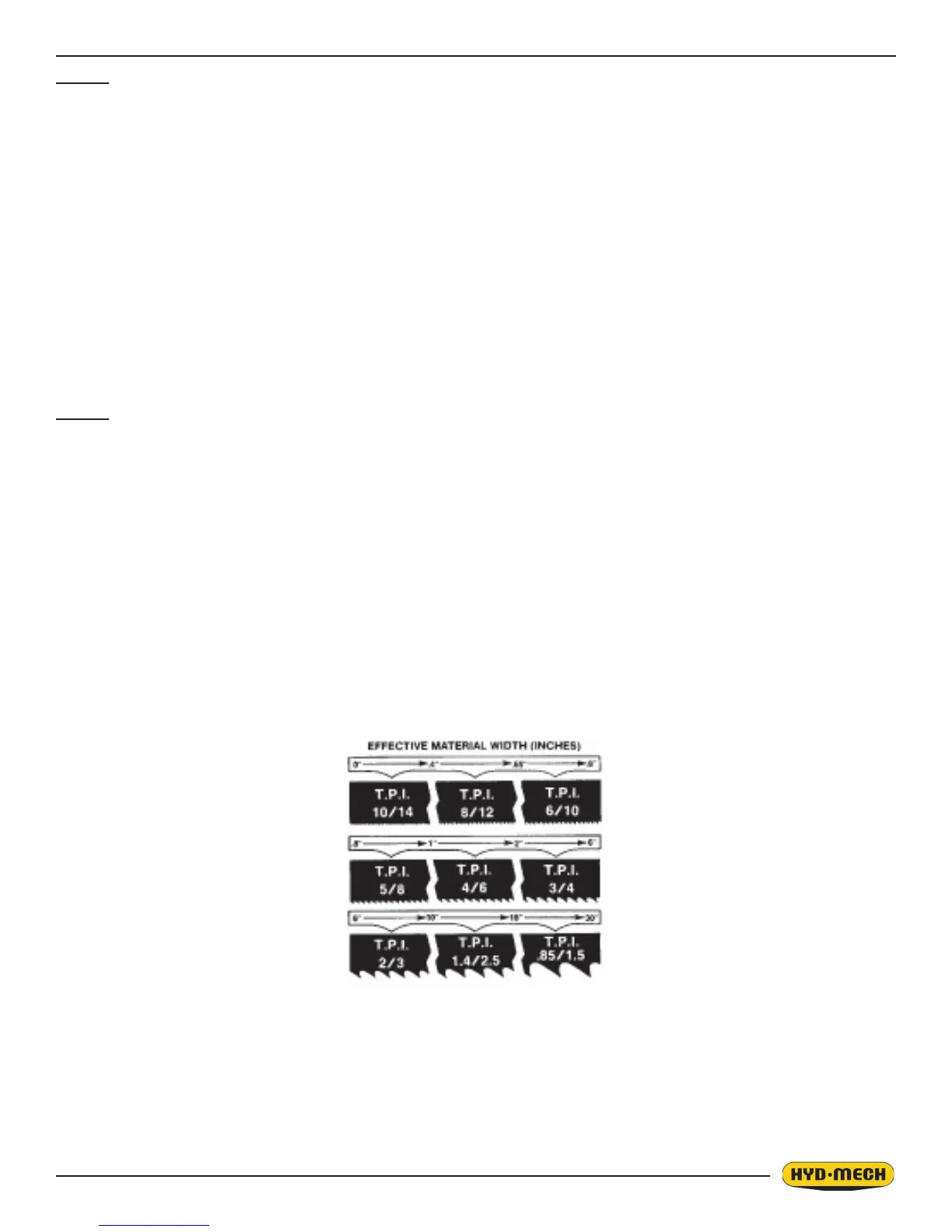
For cutting narrow or thin wall structural materials a ne blade with many teeth per inch (T.P.I.) is recommended. For wide
materials a blade with a coarse pitch should be used. The sketch can be referenced for the blade pitch changes for differ-
ing effective material widths.
It is impractical to change the blade to the proper pitch every time a different width of material is cut and it is not neces-
sary, but remember that the optimum blade will cut most efciently. Too ne a blade must be fed slower on wide mate-
rial because the small gullets between the teeth will get packed with chips before they get across and out of the cut. Too
coarse a blade must be fed slower because it has fewer teeth cutting and there is a limit to the depth of a cut taken by
each tooth. Allowance for the use of a non-optimum blade is made in STEP 5.
In our Example #1: Effective material width of 8” (200mm) and optimum blade has 2/3 teeth per inch.


 To Next Page