3.1
SECTION 3 - MAINTENANCE AND TROUBLESHOOTING
SAFETY DURING MAINTENANCE AND TROUBLESHOOTING
“Lock-Out”, or “Lock-out Tag-out” are terms that refer to procedures taken to prevent the unexpected start-up, or other
release of energy, by a machine, whenever anyone is required to remove or bypass safety guards or devices, or
whenever anyone is required to place part of his body in a hazard area.
In almost all jurisdictions, it is required that owners of industrial equipment establish and post lock-out procedures. Know
and use the lock-out procedures of your company or organization. In the absence of such posted procedures, use the
following.
LOCK-OUT PROCEDURE
Whenever work is to be performed on a machine, which requires removal or bypassing of safety guards or devices, or
placement of part of anyone’s body in a hazard area, the following steps shall be taken:
1. Operator shuts down the machine. The head must be lowered fully, or onto suitable supports, before any
hydraulic service is performed, to prevent the head from moving unexpectedly.
2. The supervisor in charge of the machine must be informed of the intention to lock-out the machine.
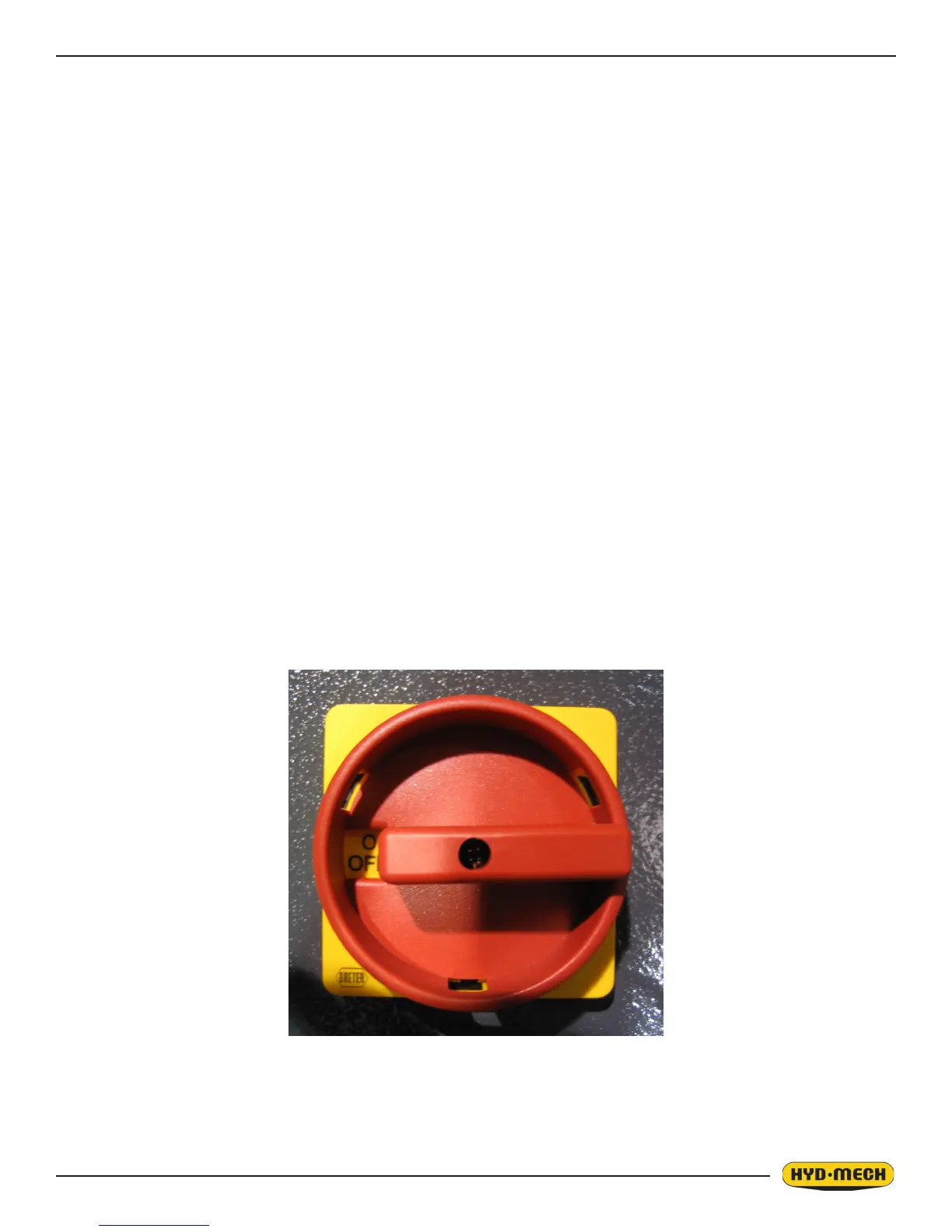
3. The main power disconnect switch must be turned off, and locked in the off position by means of a padlock.
The person performing the work on the machine must keep the key for this padlock. If more than one person is
performing the work on the machine, then a multiple lock hasp shall be used, and each person shall apply his or
her own lock to the hasp.
4. Prior to starting any work on the locked-out machine, the supervisor shall attempt to start the machine to ensure
that the lock-out device provides adequate protection. Operating control must be reset to the “OFF” position after
this test.
5. Work on the locked-out machine may now proceed.
Main power disconnect switch used for safety lockout procedures


 To Next Page