3.3
NEW BLADE BREAK-IN
To take advantage of the superiority of bi-metal blades, it is critical to properly “break-in” a new blade. The break-in
polishes the new teeth and selectively wears down teeth that may be a bit high so that they do not snag. To “Break-in” a
new blade:
1. Set the blade speed to the value indicated by the Cutting Parameter Chart.
2. Set feed rate to about half the value indicated by the chart.
3. Over a period of several cuts, gradually increase the feed rate to the full value indicated by the chart. The number
of cuts depends on the size and the toughness of the work piece – cut about 60 square inches of mild steel, or
about 30 square inches of stainless steel or tool steel.
If convenient, it is better to break-in a blade on a solid material, rather than on tubes or structurals, but even if break-in
must be performed on structurals do not skip it.
BLADE TRACKING
First, inspect the blade wheels for wear or damage and repair as required. Blade tracking adjustment should always begin
at the wheel where the tracking is farthest out of specication. Using the instructions below, adjust the worst wheel, jog
the blade, and then check both wheels. Repeat this process until both wheels are within specication: .200” - .220” (5mm
to 5.6mm) of tooth overhang from the front of the wheel. Adjustment should not be required unless the wheel is being
replaced. Hyd-Mech service should be contacted before making any adjustments to the wheel position.
DRIVE WHEEL ADJUSTMENT
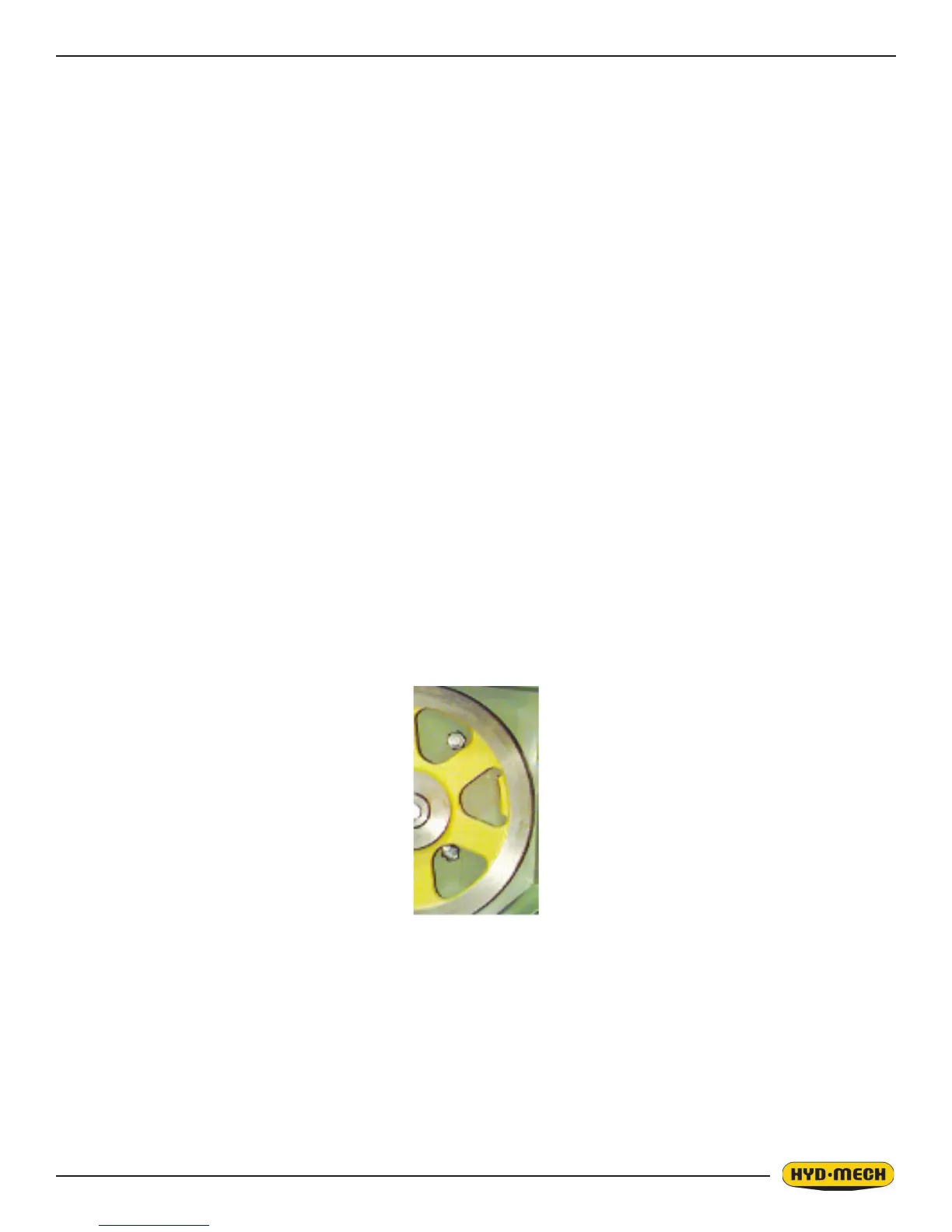
On the wall behind the drive wheel are two adjusting bolt assemblies and two hex bolts. Loosen all four of them with a
¾” socket and turn the larger hex head bolts a ¼ turn with a 1 1/8” socket and extension. Tighten the two bolts in the
assemblies, and then tighten the two bolts on the left. Turning the large hex bolts in the assemblies with the 1 1/8” socket
clockwise will pull the blade on to the wheel and turning them counter clockwise will push the blade off. Each ¼ turn will
move the blade approximately .02”.


 To Next Page