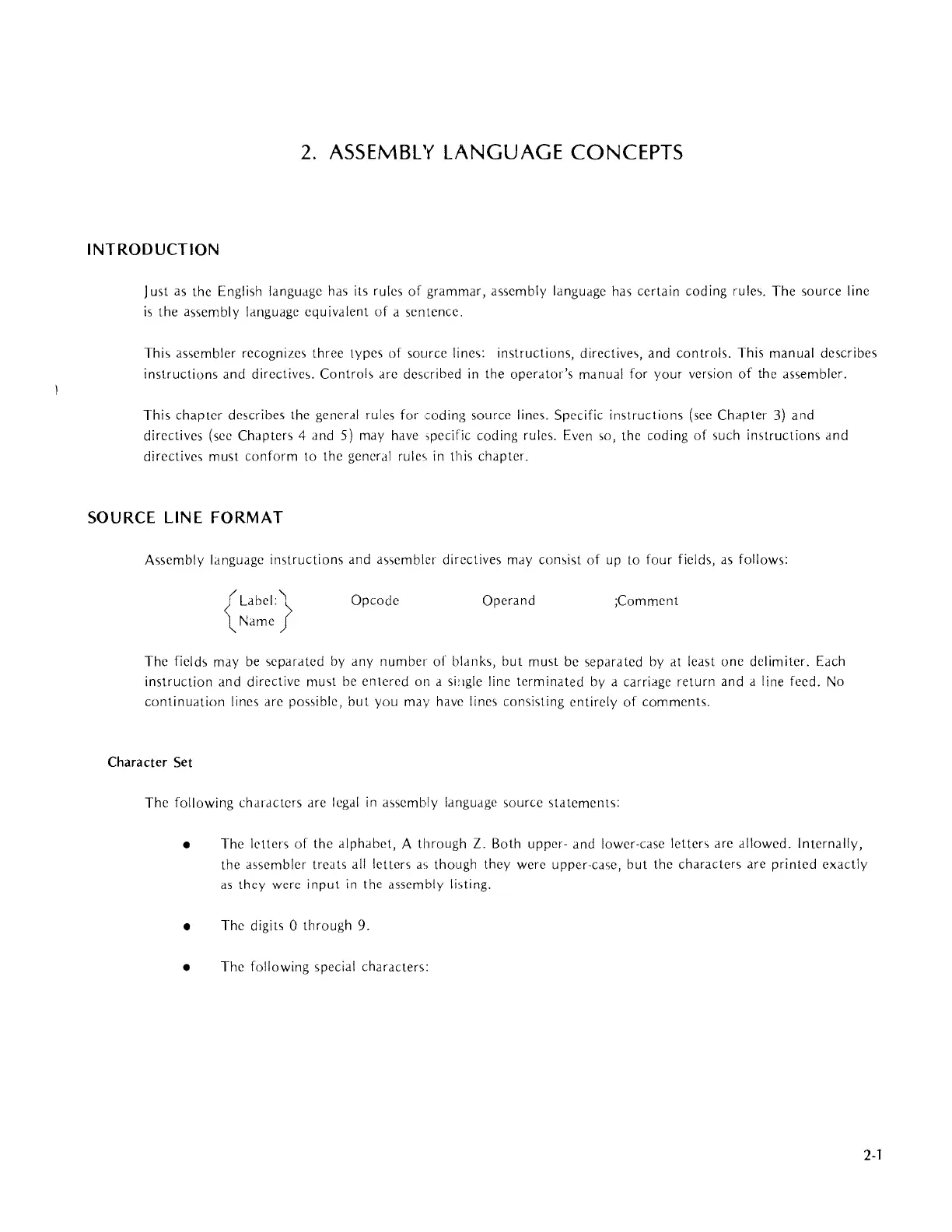
2.
ASSEMBLY
LANGUAGE
CONCEPTS
INTRODUCTION
Just as the English languJge has its rules
of
grammar, assembly IJngUJge has certain coding
rule'>.
The source line
is
the assembly IJnguage equivalent
of
a sentence.
Thi,>
Jssembler recognize'> three types
of
source lines: instructions, directive'>, and controls. This manual describes
instructions and
directive'>. Control'>
<ire
described
in
the
operJtor's
mJnual for your version
of
the Jssembler.
This chapter describes the
generdl rules for coding source lines. Specific instructions (see Chapter
3)
and
directives (see
ChJpters 4 and 5) may have >pecific coding rules. Even
'>0,
the coding
of
such instructions and
directives must conform to the general
rule'.
in
this chapter.
SOURCE LINE
FORMAT
Assembly language instructions and
a'>sembler
directives may
comist
of
up to four fields,
as
follows:
{
Label:}
Name
Opcode Operand
;Comment
The
field,>
may
be
~eparated
by
any number·
of
blanks,
but
must be separated
by
at least one delimiter. Each
instruction and directive must
be
entered on a si:rgle line terminated
by
a carriage return and a line feed.
No
continuation
lines arc
poS'>ible,
but
you may have
line'>
consisting entirely
of
comments.
Character Set
The following
characters are
legal
in
a'>Sembly
language source statements:
• The letter·s
of
the alphabet, A through
Z.
Both upper- and lower-case
letter,
<ire
allowed. Internally,
the
assembler treats
all
letters
as
though they were upper-case,
but
the characters arc printed exactly
as
they were
input
in
the assembly li·,ting.
•
The digits 0 through 9.
• The following special characters:
2-1





 To Next Page