Chapt~T
3.
ImtTu~tion
Set
MOV
3-36
MOVE
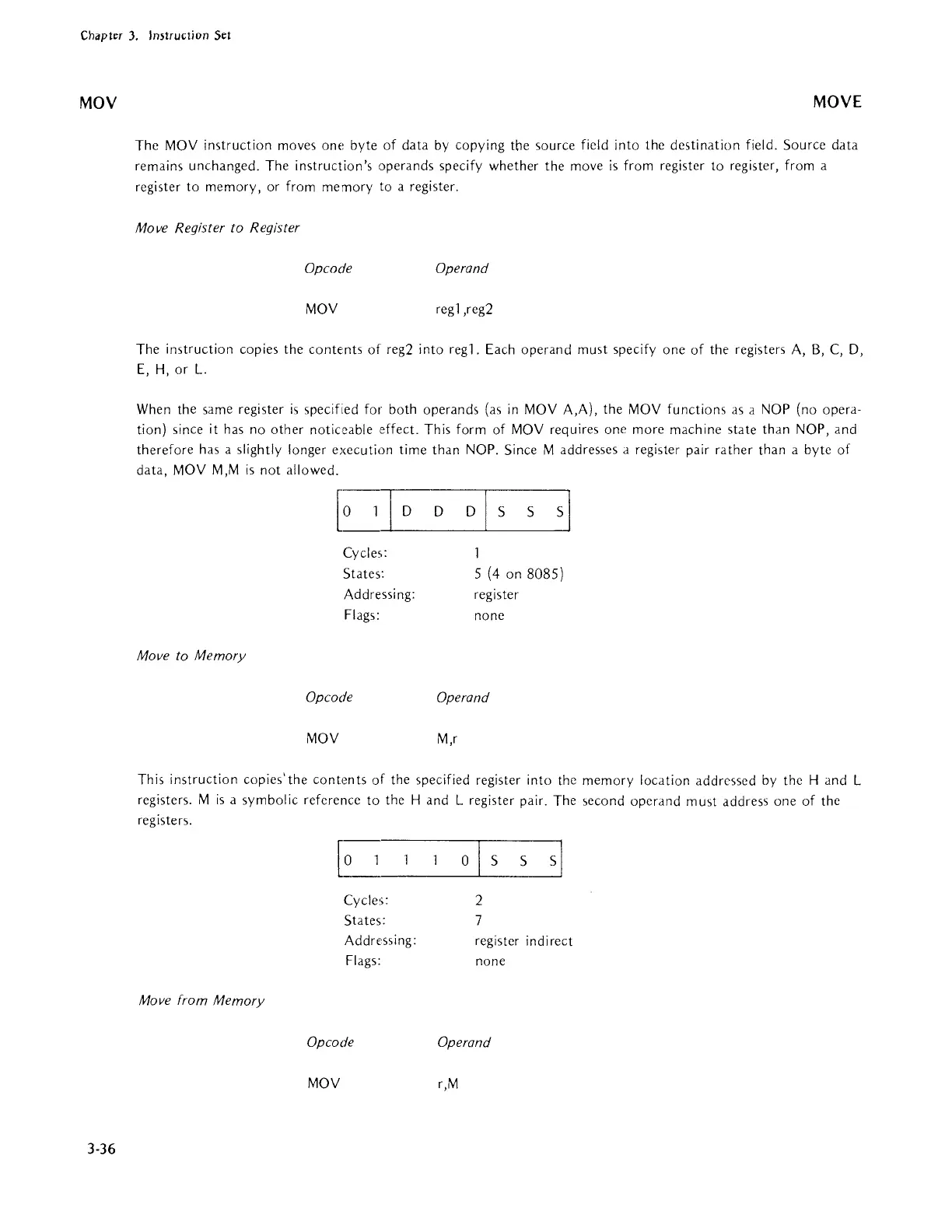
The
MOV
instruction moves one byte
of
data
by
copying the source field into the destination field. Source data
remains unchanged. The instruction's operands specify whether the move
is
from register to register, from a
register to memory, or from memory to a register.
Move Register
to
Register
Op co de Operand
MOV
regl,reg2
The instruction copies the contents
of
reg2 into regl. Each operand must specify one
of
the registers
A,
B,
C,
D,
E,
H,
or
L.
When
the same register
is
specified for both operands
(as
in
MOV
A,A), the
MOV
functions
as
a
NOP
(no opera-
tion) since it has no other noticeable effect. This form of
MOV
requires one more machine state than NOP, and
therefore has
a slightly longer execution time than
NOP.
Since M addresses a register pair rather than a byte
of
data,
MOV
M,M
is
not allowed.
D
Cycles:
States:
Addressing:
Flags:
Move
to
Memory
Opcode
MOV
D
D
5 5 5 I
5
(4
on 8085)
register
none
Operand
M,r
This instruction copies'the contents of the specified register into the memory location addressed
by
the
Hand
L
registers. M
is
a symbolic reference to the
Hand
L register pair. The
<,econd
operand must address one
of
the
registers.
[0
0
5
5
51
Cycles:
2
5 ta tes:
7
Addressing:
regis ter
indirect
Flags:
none
Move
from
Memory
Op co de
Operand
MOV
r,M









 To Next Page