Chapter
3.
Instruct"lon Set
Opcode
Operand
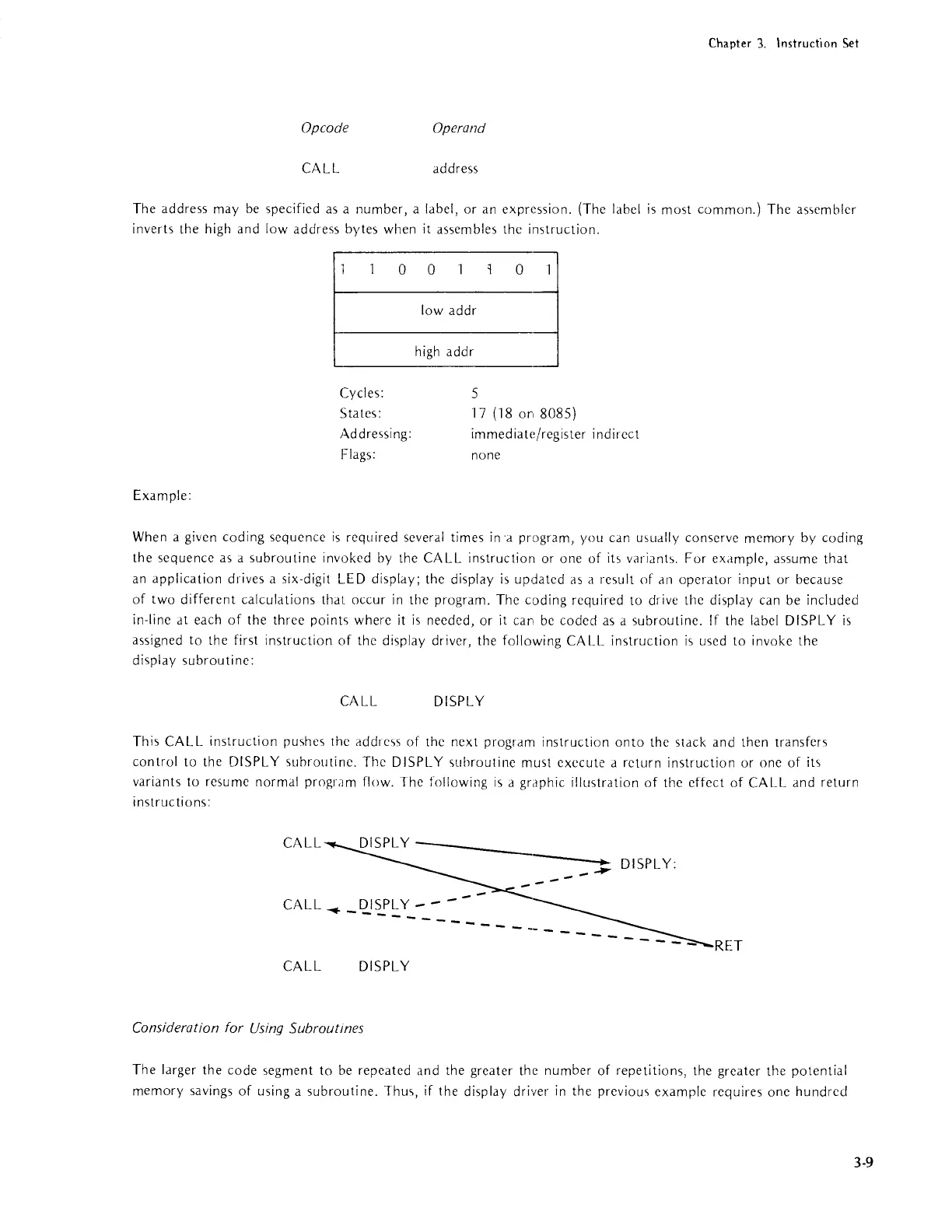
CALL address
The address
may
be
specified
as
a number, a label, or an expression. (The label
is
most common.) The as'>embler
inverts the high and low address bytes when
it
assembles the instruction.
1
1
0
Cycles:
S
ta tes:
Addressing:
Flags:
Example:
0
1
q
0 1
lowaddr
high
addr
5
17 (18 on 8085)
immediate/register indilTct
none
When a given coding sequence
is
required several times in'a program, you can usually conserve memory by coding
the sequence as
a subroutine invoked by the CALL instruction or one
of
it<,
varianI',. For example, assume that
an
application drives a six-digit
L.ED
display; the display
is
updated as a result
of
dn
operator
input or because
of
two different calculations that occur
in
the program. The coding required to drive the display can be included
in-line at each
of
the three
point,
where
it
is
needed, or
it
can
be
coded
as
a subroutine.
If
the label
DISPL.
Y
is
assigned to the first instruction
of
the display driver, the following
CAL.L.
instruction
is
used to invoke the
display subroutine:
CAL.L.
DISPL Y
This
CALL.
instruction pushes the addle)s
of
the next proglam instruction
onto
the stack and then transfers
control to the
DISPL.
Y subroutine. The
DISPL.
Y ,uilroutine must execute a return instruction or one
of
its
variants to resume normal program flow. The following
is
a graphic illustration
of
the effect
of
CAL.L
and return
instructions:
CAL.L.
--
---
_;
DISPL.
Y:
CAL.L.
~
-f2..I~~Y_-_-_~~~
___
~
------~RET
CA
L. L.
DISPL.
Y
Consideration
for
Using Subroutlt7es
The larger the code segment to
be
repeated and the greater the number
of
repetitions, the greater the potential
memory savings
of
using a subroutine. Thu" if the display driver
in
the previou, example requires one hundrecl
3-9




 To Next Page