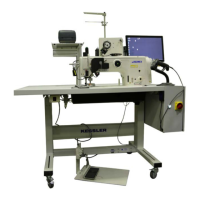
Industrial Sewing Machine SADE
35
WARNING!
Under no
circumstances should the life wire (+ DC) of internal terminal and SC922 I/O
terminal be connected. Connecting SC922 output directly to the PLC might result in
serious damage to the PLC.
Main power terminal
220VAC main power is distributed from the control unit over main power terminal to the
sewing motor, height adjustable table and optional equipment. By default the industrial
computer has a separate power supply.
With the main switch the control unit and its main power terminal is energized. The 10A
fuses protects components against electrical overload and short-circuit.
PLC
The programmable logic controller (PLC) evaluates the sewing process in real-time. It
will interact with the SC922 sewing motor control unit in a way that it will block unwanted
actions of the operator during the sewing cycle. Outputs of the SC922 are monitored.
Evaluation of the seam relies on stitch counting. All stitch number set-points are pre-
loaded from the PC into the PLC and the result will be transmitted back to the PC.
Sewing motor control unit
An SC922 sewing motor control unit drives the sewing head.
Compared to normal LU2810 configuration, the difference is the PLC unit. Critical in-
and output signals of the SC922 unit will pass through the PLC. SC922 outputs are
conditionally blocked. The sewing machine head has a direct drive motor build in.
Control panel
Fig. 10. Control panel CP-18
The control panel (OP18) is used to set
all specific sewing control parameters.
Needle positions, back tack and presser
foot
functions are accessible through this
panel like on standard LU2810 work-
stations. Panel is placed inside control
unit cabinet to prevent unauthorized
changes to the current settings.
Pedal connection
Like on normal sewing machines, a pedal is used for speed regulation. On the JUKI
SADE the signal of the pedal is directly connected with the Juki control drive.
The PLC can block the signal so that the machine won’t run if the pedal is pressed. Also
the PLC can transform the signal to emulate a different position of the pedal.


 To Next Page