Product Manuals/Man-1096M_SyncroAS Marine 16 Page 23 of 38
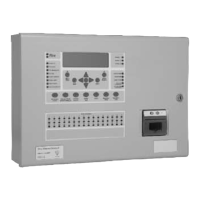
The Response repeater panel has no detection loops fitted, and is protocol independent. This panel option may be selected when
adding panels to the configuration only.
18.1.5. Default ringing mode
When control panels are supplied, the default-ringing mode is set to common alarm. In this mode, any fire condition will operate all
sounders continuously.
The mode can be changed to zonal alarm, which means that only sounders in the same zone as the signal that originated the alarm
will operate.
A third option of 2-stage alarm is also available which causes the sounders in the same zone as the signal that originated the alarm
to operate continuously and sounders in all other zones to operate intermittently.
18.1.5.1 – Marine Mode
This option applies to the Syncro ASM panel only. When selected, the two panel sounder circuits will operate in an “Abandon Ship”
mode (7 short pulses followed by a single long pulse) when an Evacuate input is activated.
The two panel sounder circuits will operate continuously on a Fire event by default, or as configured using the loop explorer
program.
Loop sounders and loop sounder control unit operation will continue to operate continuously when an Evacuate input is operated
or when there is a fire event. Their behaviour is not changed by the selection of the Marine Mode option.
18.1.6. Access level code changes
The default codes to enter access level 2 and access level 3 can be changed via the configuration programme only.
18.1.7. CHQ-BS Loop Sounders
For Hochiki systems, it is possible to select the default volume of all CHQ-BS loop powered sounders. Each sounder may be
configured independently to either the default setting or one of 10 volume settings.
NOTE: Volume settings of CHQ-WS 100dB wall sounders may not be configured from the control panel, even though this device has
the same type code as the CHQ-BS loop sounder.
This option is not available for Apollo or Argus Vega systems as the volume can be adjusted only by setting a switch on the device.
18.1.8. Panel text
A forty-character message can be entered which is displayed when the control panel is in a quiescent condition. This may be the
company name and service contact telephone number or any other message agreed with the end user.
18.1.9. Panel Modem Fitted
When selected, the panel expects a modem to be fitted to the PC port. The panel will poll the modem at 90-second intervals and
expect a response from the modem. If the modem does not respond, then a disconnected modem message will be shown on the
panel display.
18.1.10. Graphics System
When this is selected, event cleared messages will be sent to the PC port and printer port. This allows a graphics system to track
and automatically clear events, provided this facility is supported by the graphics system. This is deselected by default, to reduce
printer paper consumption. When selected, event cleared messages will be printed after each event or activation has been reset.
18.1.11 – Loop Offset
This option applies only to networked systems. By default the device address will comprise the panel number, loop number
and device address number. The loop number will be either 1 or 2 for a Syncro AS panel.
If the loop offset option is selected, the loop numbers are shown as the next incremented loop number from the previous
network panel. Therefore for a network of four AS panels, some with offset selected, the loop numbers will be as shown in
the example below
Panel 1 (Syncro AS 2 loops) – Panel 1 Loop 1, Panel 1 Loop 2
Panel 2 (Syncro AS 2 loops and loop offset selected) – Panel 2 Loop 3, Panel 2 Loop 4
Panel 3 (Syncro AS 1 loop, NO loop offset selected) – Panel 3 Loop 1
Panel 3 (Syncro AS 2 loops with loop offset selected ) – Panel 4 Loop 2, Panel 4 Loop 3
18.1.12 – Apollo Intrinsically Safe Devices
This option is only shown for the Apollo protocol panel and should be selected when using Apollo XP95 Intrinsically Safe (IS) devices
connected to the detection loop via an XP95 protocol translator and barrier arrangement.
When selected, the maximum number of detection device LED indicators that can be consecutively illuminated is reduced from the
default of 5 to 2 indicators, to reduce current through the translator / barrier hardware.
18.1.13 – Zone Indicators
This option typically applies to networked systems and allows the 16 “Fire in Zone” indicators to be re-mapped to alternative
zones in steps of 16 zones.
Therefore on a networked system with panels in different buildings, panel 1 could display zones 1-16, panel 2 displays 17-32


 To Next Page