E02016 2/02 Electrical Propulsion Components E2-1
ELECTRICAL PROPULSION COMPONENTS
GENERAL SYSTEM DESCRIPTION
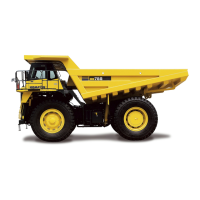
The electric propulsion and control system of the
Komatsu truck consists of an engine driven alternator
and cooling air blower, control system, wheel motors,
retarding grids and blower motor. The alternator pro-
duces A.C. current which is rectified to D.C. current.
The wheel motors use D.C. current to operate as
motors in propulsion and generators in retarding.
When the operator selects FORWARD or REVERSE
propulsion, the armatures of the motors drive planetary
gear sets connected to the rear wheels to propel the
truck in FORWARD or REVERSE.
During truck operation, the operator initiates command
signals to the engine and control system. The signals
are received at the FL275 electronic card panel initiat-
ing a series of checks to determine the status of sys-
tem components. After checking the control system,
the FL275 panel energizes the necessary contactors to
set up the control system for propulsion or retarding
and send a control signal to the static exciters.
During it's operation, the FL275 panel maintains the
propulsion system within the design limits of the alter-
nator, engine, and wheel motors. Regulation of alterna-
tor field current and engine speed determine traction
motor armature current. Regulation of motor field cur-
rent determines traction motor horsepower.
The control system responds to electrical signals gen-
erated by the operator and by “feedback” signals gen-
erated by various devices within the system. These
feedback signals monitor voltage, current, speed, etc.
of the various control and propulsion equipment.
When the operator depresses the retard pedal or the
truck exceeds the automatic overspeed setting, the
dynamic retarding circuit is activated causing the wheel
motors to become generators. The truck momentum
causes the armatures of the wheel motors to rotate,
generating a D.C. output that is applied across the
retarding grids. This load opposes armature rotation to
slow the truck. The energy from the wheel motor is dis-
sipated in the retarding grids in the form of heat.
Retarding grid cooling is provided by a motor-driven
fan, blowing air across the grids. The cooling air blower
connected in-line to the rear of the alternator provides
cooling air for the static exciters, alternator and wheel
motors during truck operation.
Refer to the following information for detailed descrip-
tions of component functions.
CONTROL SYSTEM
The Statex III control system electronics provide all of
the functions necessary to initiate and regulate opera-
tion of the truck. It monitors operator input and system
feedback signals, calculates a response, and initiates
the appropriate control action.
The system . . . .
• Establishes the propulsion circuit by energizing
contactors P1, P2 (if installed), MF, GF, and
GFR to power the wheelmotors.
• Establishes the retarding circuit by energizing
contactors MF, GF, GFR, RP1, RP2, RP3, RP4,
RP5, (and optionally RP6, RP7, RP8 and RP9)
for extended range retarding to connect grid
resistors RG1 and RG2 in the motor circuits.
Extended range retarding is regulated automati-
cally by sequentially energizing the RP3-RP9
contactors.
• Provides current limit control so that specific
rates may be maintained in both motoring and
retarding.
• Provides Retard Speed Control for automatic
speed regulation on long down-hill runs.
• Provides two-speed overspeed control which
allows a higher overspeed restriction when trav-
eling empty.
• Provides Alternator Tertiary Winding protection
and Wheelmotor overcurrent protection.
• Initiates the necessary operating restrictions,
including the shut down of the truck if a system
fault is detected. Lesser faults or events cause
respective indicating lights to light. All events
are recorded for future review by technicians.
• Provides fault/event information to the operator/
technician as to the status of the system via the
2-digit display panel, located in the control cabi-
net. This panel, showing a two digit display of
00 to 99, indicates to the technician the exist-
ence of possible faults or other events which
have occurred within the control and/or propul-
sion system.
• Provides automatic and manual diagnostic self-
test routines to detect faults and to assist main-
tenance personnel in locating a poorly operat-
ing system/subsystem.
• Provides a statistical data history log which indi-
cates lifetime, quarterly, monthly and daily per-
formance data. This history log can be
accessed using a “laptop” computer, and can
be a valuable aid in determining equipment use
and maintenance schedules.



 To Next Page