2.4.3 Radiation 15
| www.lakeshore.com
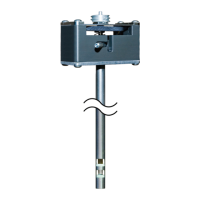
Example of zero error: assume that the Model 425 is zeroed at +25 °C and then the tem-
perature rises to +50 °C (,T = +25 °C). For an HMMT-6J04-VR, the worst-case zero
drift would be ±0.09 G/°C × 25 °C = ±2.25 G (maximum).
This is the maximum temperature error to be expected. Most Lake Shore probes exhibit
lower temperature coefficients.
2.4.2.2 The Temperature Coefficient of Sensitivity (Calibration)
The temperature coefficient of sensitivity is related to a change in the magnetic sensi-
tivity of the Hall device with temperature. This change is present only when a field is
measured. The larger the field, the greater the error in G for the same temperature
change.
This characteristic is present in all probes and is specified in units of %G/° C. The
intrinsic value is always negative for Lake Shore HSE and HST probes, meaning that
the sensitivity of the Hall sensor decreases with increased temperature. Therefore,
the reading will be lower than the actual magnetic field when the probe is at a tem-
perature higher than room temperature. Lake Shore Hall probes are calibrated at
room temperature (25 °C); when they are used in temperatures other than this, tem-
perature coefficient becomes another source of error. Lake Shore HST probes nor-
mally exhibit a temperature coefficient of sensitivity about ten times better (lower)
than the HSE probes.
Simply handling the probe at the stem can cause sufficient temperature change of the
sensor, which can cause the reading to drift; handling the probe by the stem is not recom-
mended as it can break the probe.
Examples of sensitivity error: assume that the Model 425 is zeroed at +25 °C and then
the temperature rises to +50 °C (Delta T = +25 °C). For an HMMT-6J04-VR and
Model 425 (no compensation), measuring a 1.000 kG field, the worst-case sensitivity
change would be -0.04%/°C × 25 °C = -1% (maximum); -1% of 1.000 kG = -10 G
(reads low 10 G).
Also note that if the probe were a Model HMMT-6J04-VF, the worst case sensitivity
change would be -0.005%/°C × 25 °C = -0.125% (maximum); -0.125% of 1.000 kG =
-1.25 G (reads low 1.25 G).
This is the maximum temperature error to be expected. Most Lake Shore probes exhibit
lower temperature coefficients.
2.4.3 Radiation
The HST and HSE probes use a highly doped indium arsenide conductor. The HST
material is the more highly doped of the two and therefore will be less affected by
radiation. Some general information relating to highly doped indium arsenide Hall
generators is provided in the following list. The changes in sensitivity are the maxi-
mums expected if the sensor is exposed at the given rates indefinitely.
D Gamma radiation seems to have little effect on the Hall generators
D Proton radiation up to 10 Mrad causes sensitivity changes less than 0.5%
D Neutron cumulative radiation (>0.1 MeV, 10
15
/cm
2
) can cause a 3% to 5%
decrease in sensitivity
In all cases the radiation effects on the Hall sensors seem to saturate and diminish
with cumulative exposure; the length of time for these effects to diminish varies
depending upon radiation intensity.


 To Next Page