16 cHAPTER 2: Background
Model 425 Gaussmeter
2.5 Probe
Considerations
This section defines and discusses things to consider when selecting a probe.
2.5.1 Orientation
Because accessing the field is part of the challenge when selecting a probe, field ori-
entation dictates the most basic probe geometry choice of transverse versus axial.
Other variations are also available for less common, more challenging applications.
Listed below are the standard configurations for HSE and HST probes; UHS probes
require special construction that is not described here.
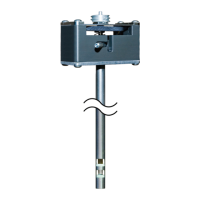
D Transverse: most often rectangular in shape, transverse probes measure fields per-
pindicular to their stem width. They are useful for most general purpose field
measurements and are essential for work in magnet gaps. Several stem lengths
and thicknesses are available as standard probes.
D Axial: usually round, axial probes measure fields perpindicular to their end. They
can also be used for general-purpose measurements, but are most commonly
used to measure fields produced by solenoids. Several stem lengths and diame-
ters are available as standard probes.
D Flexible: with a flexible portion in the middle of their stem, flexible probes have an
active area at the tip that remains rigid and somewhat exposed. This unique fea-
ture makes them significantly more fragile than other transverse probes. Flexible
probes should only be selected for narrow-gap measurement applications.
D Tangential : these probes are transverse probes designed to measure fields parallel
to and near a surface. The active area is very close to the stem tip. These probes
are intended for this specific application and should not be selected for general
transverse measurements.
Flexible and tangential probes are significantly more fragile than other transverse
probes.
D Multiple axis: multi-axis probes are available for multi-axis gaussmeters like the
Lake Shore Model 460. These probes are not compatible with the Model 425.
2.5.2 Frequency
Hall effect gaussmeters are equally well suited for measuring either static, DC fields
or periodic, AC fields, but proper probe selection is required to achieve optimal
performance. HST probes are not recommended for use in wide band mode because
of their lower sensitivity. These probes perform better with the the noise cancellation
benefits of the narrow band mode.
D Metal stem: these probe stems are the best choice for DC and low frequency AC
measurements. Non-ferrous metals are used for probe stems because they
provide the best protection for the delicate Hall effect sensor without altering
the measured field. Aluminum is the most common metal stem material, but
brass can also be used. Metal stems do have one drawback: eddy currents are
generated in them when they are placed in AC fields. These eddy currents oppose
the field and cause measurement error. The error magnitude is proportional to
frequency, and is most noticeable above 800 Hz.
D Non-metal stem: these probe stems are required for higher frequency AC fields and
for measuring pulse fields—fiberglass/epoxy is a common non-metal stem
material. Alternatively, the Hall effect sensor can be left exposed on its ceramic
substrate, but provides less protection for the sensor. Eddy currents do not limit
the frequency range of these non-conductive materials, but other factors may.
None of these probe types are suitable for direct exposure to high voltage. The possibility
exists for damage to equipment or injury to the operator if the probe is exposed to high
voltage.


 To Next Page