2.7.3 Probe Design 19
| www.lakeshore.com
2.7.3 Probe Design
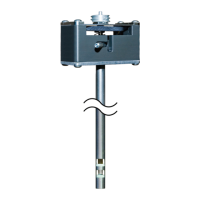
The HMCA-2560-WN and HMCT-3160-WN probes are long, rigid tubes designed
mainly for entry into Dewars through o-ring fittings. This physical configuration may
not fit all applications, in particular those where the measurement volume is not in
direct line with an entry port. Contact Lake Shore Applications Engineering to discuss
any specific physical requirement. Special configurations are available, and new
probe designs can be quoted. If probes are not suitable for your application, cryogenic
Hall generators are also available.
2.8 Hall Generator
Hall probes may not be suitable in applications with size constraints or in difficult
mounting situations. In these cases, Hall generators may be used. Hall generators
come in different configurations and sizes. Cryogenic Hall generators are also avail-
able. Most Hall generators come with a single point sensitivity calibration that can be
entered into the Model 425 (refer to section 5.5.1). Some Hall generators are avail-
able with full calibrations, but this data needs to be processed outside the Model 425;
it will only use the nominal sensitivity. Refer to the Magnetics Catalog on the
Lake Shore website for a list of Hall generators that are available.
Hall generators are very fragile and require delicate handling. The ceramic substrate
used to produce the Hall sensor is very brittle. Use the leads to move the Hall genera-
tor. Do not handle the substrate. The strength of the lead-to-substrate bond is about
198.5 g (7 oz), so avoid tension on the leads and especially avoid bending them close
to the substrate. The Hall generator is also susceptible to bending and thermal
stresses.
Care must be exercised when handling the Hall generator. The device is very fragile.
Stressing the Hall sensor can alter its output. Any excess force can easily break the Hall
generator. Broken Hall generators are not repairable.


 To Next Page