24 cHAPTER 3: Installation
Model 425 Gaussmeter
3.6 Probe
Handling and
Operation
To avoid damage and for best results during use, probes have a number of handling
and accuracy requirements that must be observed.
Probes used with the gaussmeter have conductive parts. Never probe near exposed live
voltage. Personal injury and damage to the instrument may result.
3.6.1 Probe Handling
Although every attempt has been made to make the probes as sturdy as possible, they
are still fragile. This is especially true for the exposed sensor tip of some transverse
probes. While taking measurements, be careful not to place pressure on the probe tip.
Care must be exercised when handling the probe. The tip of the probe is very fragile.
Stressing the Hall sensor can alter its calibration. Any excess force can easily break the
sensor. Broken Hall sensors are not repairable.
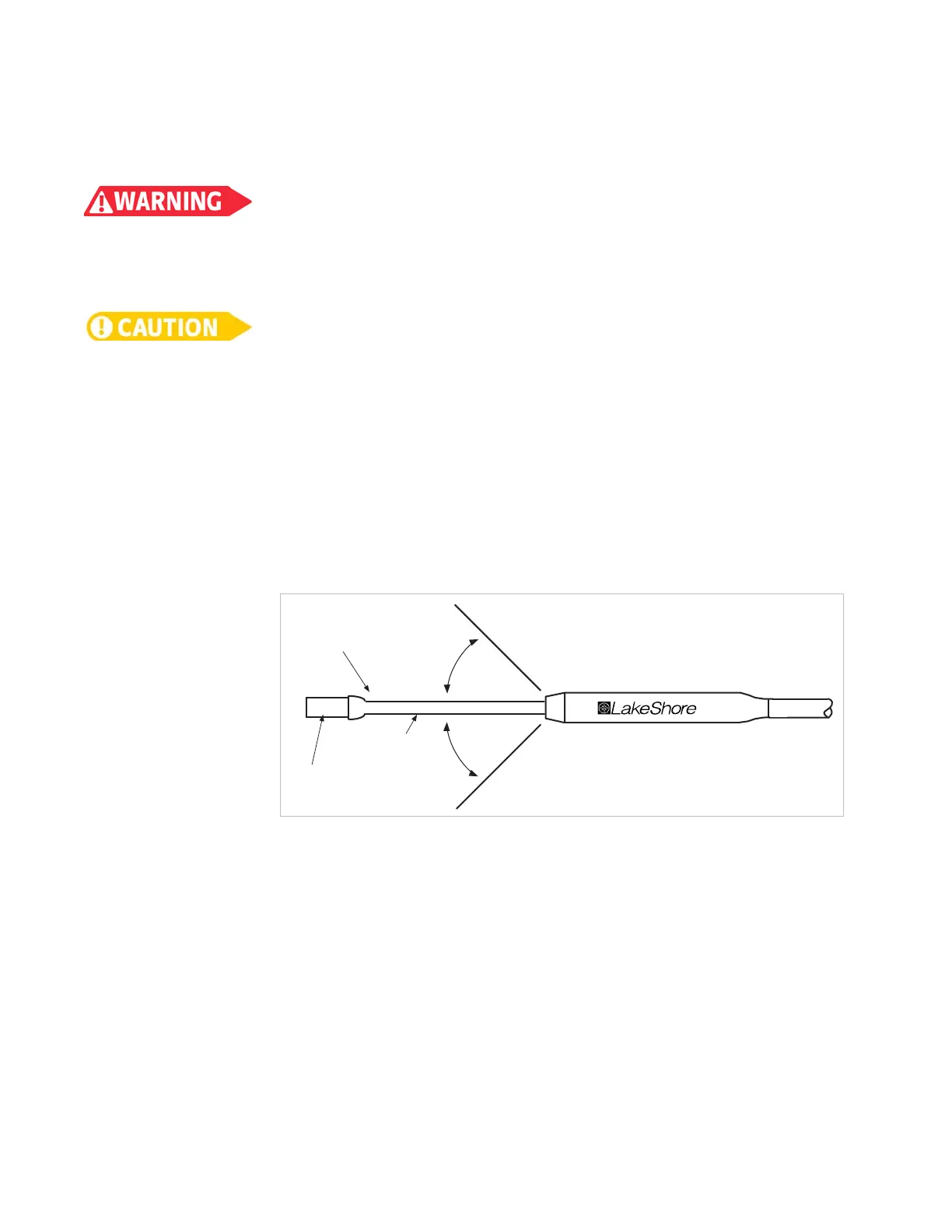
Avoid repeated flexing of the stem of a flexible probe. As a rule, the stem should not be
bent more than 45° from the base (FIGURE 3-4). Force should never be applied to the
tip of the probe. On all probes, do not pinch or allow cables to be struck by any heavy
or sharp object. Although damaged or severed cables should be returned to
Lake Shore for repair, understand that probes are not always repairable.
When probes are installed on the gaussmeter but are not in use, the protective tubes
provided with many probes should be placed over the probe handle and stem in order
to protect the tip. The cardboard and foam container that Lake Shore probes are
shipped in should be retained for probe storage when the gaussmeter is not in use.
For further details on available accessories and probes, refer to Chapter 7.
3.6.2 Probe Mounting
The probe should only be held in place by securing it at the handle. Do not apply force
to the probe stem. The stems are not designed to handle clamping forces. Clamping to
the stem can also strain the sensor and alter the probe calibration, and excessive
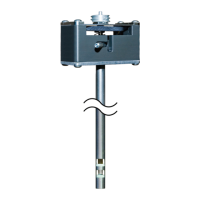
force may destroy the Hall sensor. Lake Shore offers two probe stands for mounting
your probe. FIGURE 3-5 shows a probe properly mounted using a Lake Shore probe
(P/N 4030-12 or 4030-24) stand.
FIGURE 3-4 Maximum flexible transverse probe bend radius
45°
45°
Stem
Flexible transverse probe
maximum bend angle
Do not bend from
tip of probe
The tip is
VERY FRAGILE


 To Next Page