18 cHAPTER 2: Background
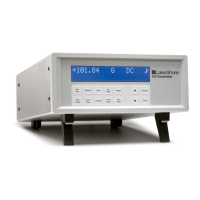
Model 425 Gaussmeter
2.6.3 Calibration
Tolerance of instrument, probe, and magnet must be considered for making critical
measurements. The accuracy of the gaussmeter reading is typically ±0.20% of read-
ing and ±0.05% of range, but the absolute accuracy readings for gaussmeters and
Hall probes is a difficult specification to give, because all the variables of the mea-
surement are difficult to reproduce. Differences in alignment and positioning will
degrade measurement accuracy and repeatability. Finally, the best probes have an
accuracy of ±0.10%. This implies that the combined accuracy of a magnetic field
measurement will not reliably be better than ±0.20% of reading, and is likely to be
0.30% or higher.
2.6.4 Off-Axis Effects
In the unusual circumstance where a large off-axis field is present when making a
measurement, this off-axis field generates an error. An example of this is when trying
to read a small transverse field in a high field solenoid. This error occurs because there
are geometric limitations in the manufacturing of the sensors. Additional errors can
be caused by the planar Hall effect and magneto resistance. The amount of reading
error can be as much as a few percent of this off-axis field. This is significant when the
off-axis field is many times larger than the field of interest. There is no way to distin-
guish this error from what is the desired field reading unless the off-axis field can be
eliminated.
2.6.5 Induced AC
Voltage
When measuring AC fields, the stray AC fields that are present can induce a voltage on
the leads which results in reading error. The effect of this error increases with fre-
quency and proximity to the field being measured. The induced voltage can be many
times greater in magnitude than the actual field being measured. Care should be
taken to keep the probe stem and cables away from the field being measured to mini-
mize this error.
2.7 Cryogenic
Measurement
Considerations
Magnetic field measurements are often taken in very cold environments. Conditions
inside superconducting magnets and around many high-energy physics experiments
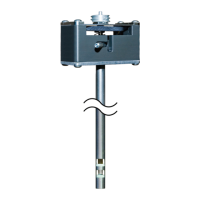
involve cryogenic temperatures. Lake Shore offers two Model 425 gaussmeter probes
capable of operation in temperatures down to 1.5 K (-271.65 °C). These are the axial
HMCA-2560-WN and the transverse HMCT-3160-WN (for cryogenic probe specifica-
tions, refer to the Magnetics Catalog on the Lake Shore website). Section 2.7.1
through section 2.7.3 discuss several factors that may affect either the accuracy or
lifetime of these probes.
2.7.1 Thermal Stresses
Care must be taken to minimize the thermal expansion stress rate during exposure to
or removal from cryogenic temperatures. If possible, allow the temperature to
change at a slow rate. Sudden dipping into cryogenic liquid or removal to room tem-
perature is not advised. Even with the greatest of care, cryogenic probes have a finite
lifetime directly related to the number of times they are cycled from room tempera-
ture to cryogenic temperatures and back.
2.7.2 Temperature
Coefficients
The magnitudes of the zero and sensitivity temperature coefficients (section 2.4.2.1
and section 2.4.2.2) are amplified substantially by the large temperature changes
from room to cryogenic temperatures. The approximate magnitude of the error can
be found in a table with the probe specifications. Refer to the magnetics catalog for
details. Note that this function is not a linear relationship between room tempera-
ture and 1.5 K (-271.65 °C).
If the gaussmeter can be zeroed after the probe reaches the final temperature, then
the zero temperature coefficient is nullified. However, if zeroing is not possible at
operating temperature, then its effect must be considered. Especially in low field
measurements <100 G (0.01 T), the zero offset change must be manually determined
and recorded so it can be used for data correction.


 To Next Page