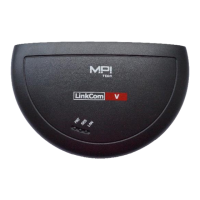
LinkCom 5 User Manual
Page 13
4 Features of LinkCom 5
LinkCom 5 is delivered preinstalled with features and options according to the
purchased product license. Additional functions, e.g. transforms, full colour, high
speed printing, etc. can be purchased and activated later.
4.1 Overview of LinkCom 5.
LinkCom 5 is a standalone hardware PrintServer.
LinkCom 5 can connect to various types of host and midrange systems and process
host print input to address the needs of heterogeneous print environments. It
provides a method to receive host print data via TCP/IP host attachments, convert
host print data to a format that can be printed on LAN (or USB printers), and
redistribute output to existing LAN print devices. LinkCom 5 provides conversion of
IPDS, ICDS and SCS/DCA host data streams into PCL5/5c or PostScript languages.
Conversion for matrix printing is also possible with IPDS, SCS and DCA host
printing.
LinkCom 5 is licensed to meet the requirements of the actual installation. The
license resides inside the LinkCom 5 PrintServer and enables usage of the
purchased features. Licenses for additional features can be applied and enabled
using PrintGuide.
IPv6 and IPv4 protocols are supported on both incoming and outgoing
communication.
Gigabit speed to and from the PrintServer is supported on the LAN port. 10/100
Mbit is supported on both the LAN and PRT ports.
PrintGuide is used to discover, monitor and configure MPI Tech PrintServers
including the hardware PrintServer LinkCom 5. PrintGuide is used to configure,
backup, alter, and restore configuration settings for PrintServers. LinkCom 5
software updates are installed via PrintGuide.
LinkCom 5 is also equipped with an internal web server for displaying basic
settings. Some configurations possible with PrintGuide, can also be made via the
web server.
4.2 End to end control
Using a direct TCP/IP connection with the printer will allow enhanced end to end
control with LinkCom 5. The LinkCom 5 PrintServer receives status feedback from
the printer and sends the true page count to the AS/400 or mainframe S/390 host
systems. The number of printed pages reported back to the mainframe will always
be the number of printed pages in the printer’s output bin.



 To Next Page