4.4 Setting Methods for Main Items
63
WF1973/WF1974
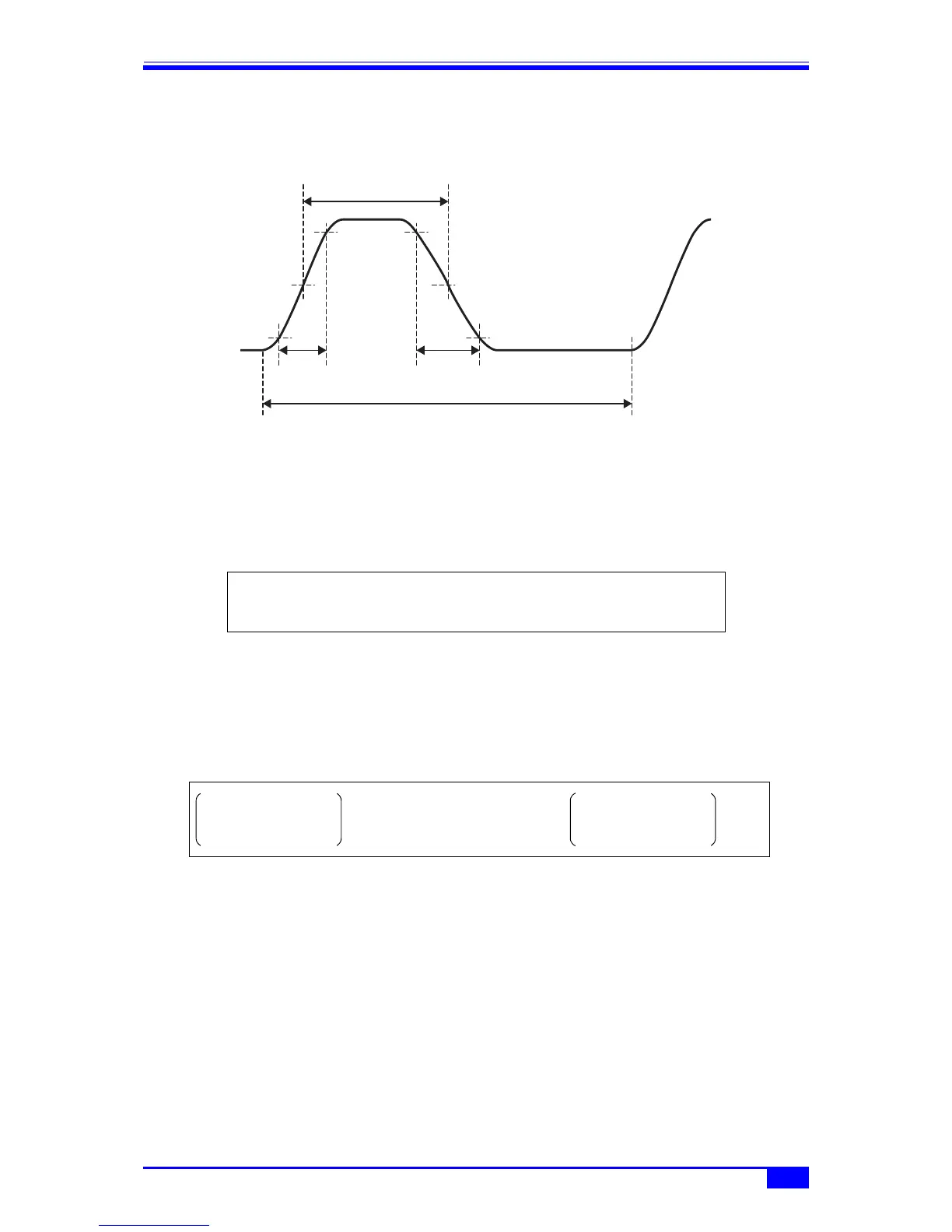
f) Pulse width, leading edge time, and trailing edge time definitions and limitations
The pulse width, leading edge time, and trailing edge time are defined as shown in the
following figure.
However, the setting ranges of the pulse width, leading edge time, trailing edge time, and
frequency are mutually limited as follows.
If the following limitations are not met by the frequency or pulse width setting, the leading
edge time and trailing edge time are adjusted first, and the pulse width is adjusted next.
■ Leading edge time and trailing edge time limitations
The ranges of the leading edge time, trailing edge time, and frequency or cycle are limited as
follows.
For example, the leading edge time and trailing edge time at 1 kHz are limited to 100 ns or
more.
■ Pulse width, leading edge time, and trailing edge time limitations
The ranges of the pulse width time, leading edge time, trailing edge time, and frequency or
cycle are limited as follows. If the pulse width is set with duty, the value converted to time is
used as the pulse width time.
For example, when the leading edge time and the trailing edge time are each set to 100 ns at
1 kHz, the pulse width time can vary in the range of 170 ns to 999.83 µs.
0%
10%10%
50%50%
90% 90%
100%
Pulse width
Period
Trailing edge timeLeading edge
time
Largest of 0.01% of period or 15 ns ≤ Leading edge time
Largest of 0.01% of period or 15 ns ≤ Trailing edge time
× 0.85 ≤ ≤ Period -
Leading edge time
+
trailing edge time
Leading edge time +
trailing edge time
× 0.85
Pulse width
time


 To Next Page