44
Wiring Formations Section 3-1
3-1 Wiring Formations
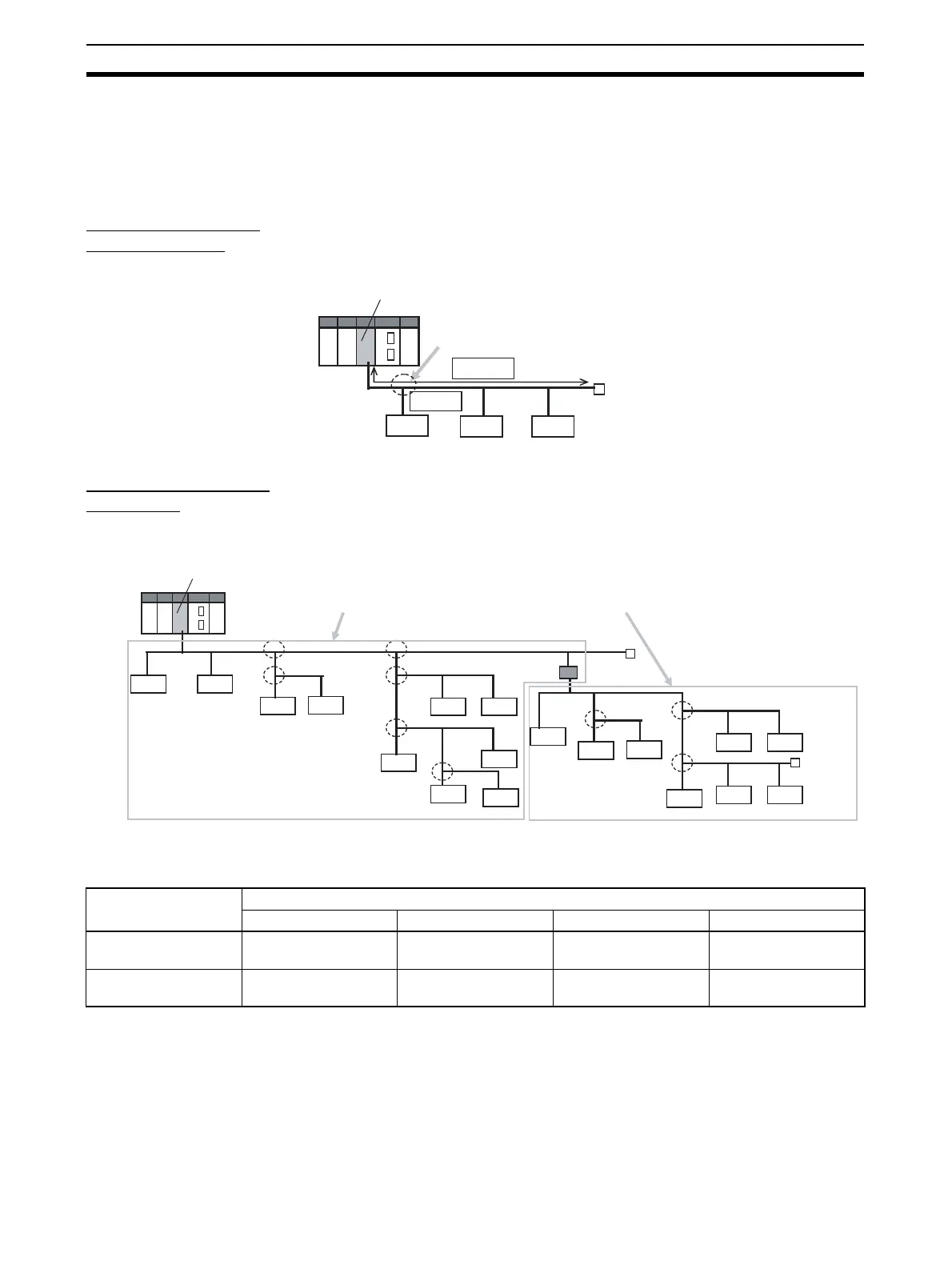
A CompoNet network can take two wiring formations: Trunk line−Branch line
and Unrestricted Wiring.
Trunk Line-Branch
Line Formation
With this wiring formation, the trunk line is differentiated from branch lines.
There are restrictions on the number of branches and the number of Units that
can be connected.
Unrestricted Wiring
Formation
With this wiring formation, there is no differentiation between the trunk line
and branch lines.
There are no wiring restrictions as long as the total cable length does not
exceed 200 m. There is also no limit on the number of branches.
The formation is determined automatically by the type of cable used and the
required baud rate.
Note Lines cannot be branched from the trunk line if the baud rate is 4 Mbps. Only
multidrop connections can be used for branching from the trunk line.
Master Unit: The Master Unit must be on one end of the network.
Only one level of branching is possible from the trunk line.
Trunk line
Branch line
Slave Unit
Terminating Resistor
Branch line
Branch line
Slave Unit
Slave Unit
Master Unit: The Master Unit does not necessarily have to be on one end of the network.
There is no differentiation between a trunk line and branch lines, and there are no restrictions in
branching as long as a maximum of 32 Slave Units and a total line length of 200 m are not exceeded.
Slave Unit
Terminating Resistor
Repeater Unit
Slave Unit
Slave Unit Slave Unit
Slave Unit
Slave Unit
Slave Unit Slave Unit
Slave Unit
Slave Unit
Terminating
Resistor
Cable type Baud rate
4 Mbps 3 Mbps 1.5 Mbps 93.75 kbps
Round Cable I Trunk-Branch (See
note.)
Trunk-Branch Trunk-Branch Trunk-Branch
Round Cable II, Flat
Cable I, or Flat Cable II
Trunk-Branch (See
note.)
Trunk-Branch Trunk-Branch Unrestricted




 To Next Page