45
CompoNet Network Wiring Section 3-2
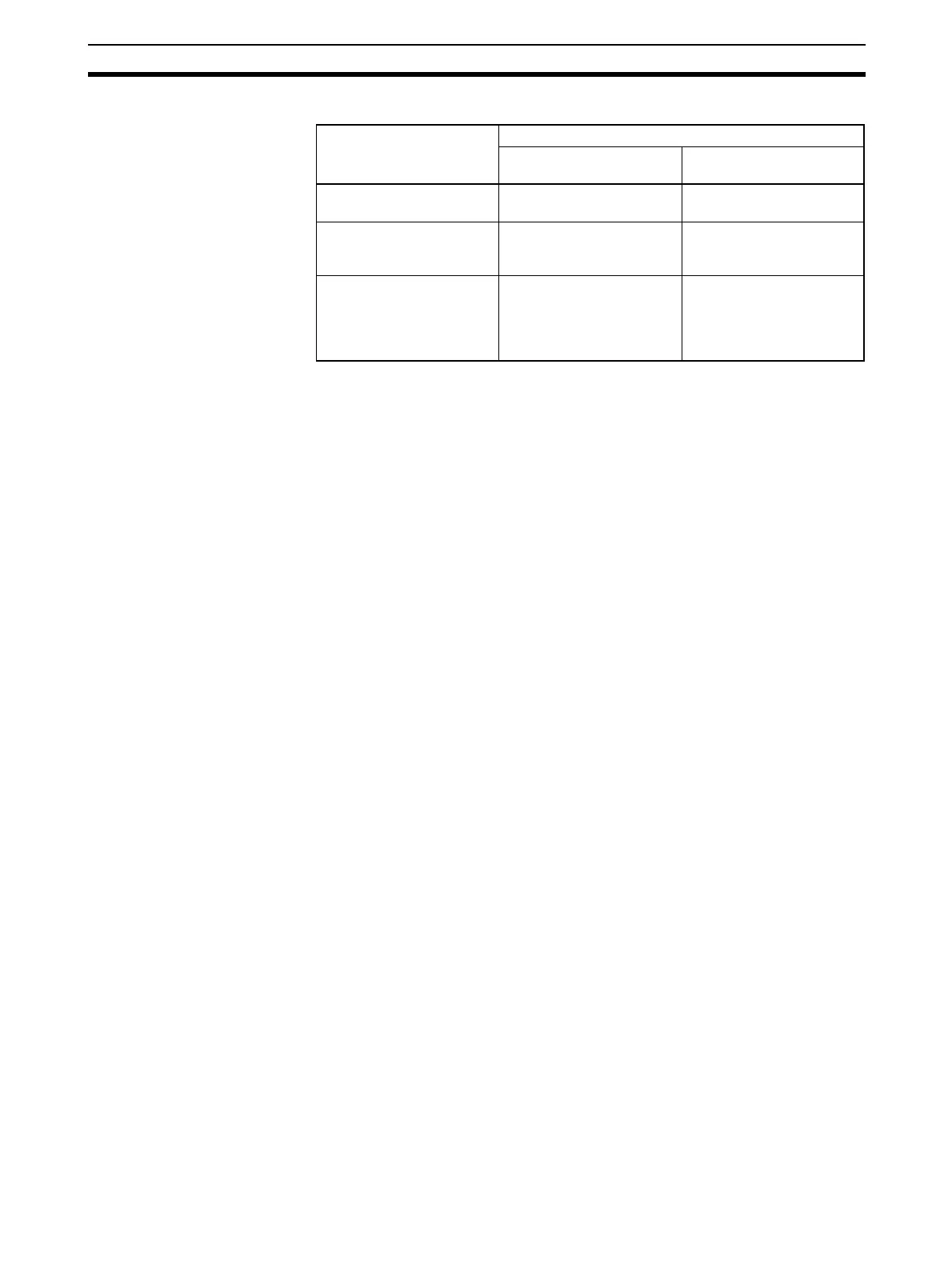
The following table shows the conditions and restrictions for each formation.
3-2 CompoNet Network Wiring
A CompoNet Network requires wiring of following lines.
• Two communications signal lines: BDH (communications data high) and
BDL (communications data low),
• Two communications power supply lines: one for communications, and
the other for internal circuits of Slave Units. Terminals are BS+ (+ terminal
of communications power supply) and BS
− (−terminal of communications
power supply).
The wiring method depends on the cable type.
3-2-1 Round Cable I
• The two communications signal lines are connected in parallel between
the Master Unit or a Repeater Unit and multiple Slave Units.
• A DCN4-TB4 Open Type Connector is used to connect the communica-
tions cable between the Master Unit or a Repeater Unit and a Slave Unit.
• The two communications power supply lines are connected to each Slave
Unit. The supply lines must be different lines from the communications
lines. The communications power supply lines supply 24-VDC communi-
cations power.
• The Master Unit and the connected Repeater Units are not supplied with
power.
• A DRS1-T Terminating Resistor must be connected at the end of the net-
work.
Item Wiring formation
Trunk−Branch formation Unrestricted wiring
formation
Master Unit location At an end of a network Anywhere in a network (not
necessarily at an end)
Maximum number of Slave
Units connectable to any
one branch line
1 or 3 depending on the
cable type and the baud
rate
No restrictions
Terminating Resistor loca-
tion
On the opposite ends of
the trunk line and all sub-
trunk lines from the Master
Unit and each Repeater
Unit
On the farthest ends from
the Master Unit and each
Repeater Unit




 To Next Page