sg_release(target_width, tool_index=0, blocking=True,
depth_compensation=False)
target_width: The width that the gripper will open to. [mm]
tool_index: The index of the gripper to send the command to.
blocking=True: the function waits for the gripper to finish the grip command.
depth_compensation=False: The robot will move during the release to compensate for the
dierence in depth between the start and the end. (False by default)
For example, a relative movement for quickly releasing a workpiece can be done as follows:
If only one gripper is connected:
sg_release (sg_Width_primary+5, 1) → for primary
sg_release (sg_Width_secondary+5, 2) → for secondary
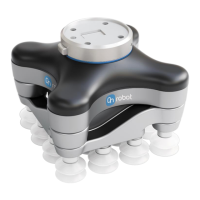
6.3.6. VG10/VGC10
vg10_grip (channel, vacuum, timeout, alert, tool_index)
Commands the VG10 to perform a grip.
channel: Tells which channel to be gripped with.
0 = Channel A
1 = Channel B
2 = Channel A and Channel B
If not set, this parameter defaults to 2 (A and B).
vacuum: Tells how hard to grasp in the range of 0% to 80 % vacuum.
60 = 60% vacuum. A typical
firm grip
30 = 30% vacuum. A typical soft grip
If not set, this parameter defaults to 60%.
timeout: Tells how long to wait for commanded vacuum to be achieved. If vacuum is not
achieved, an air leakage at the workpiece or vacuum cups is reported in a popup and the
robot program stops.
0 = The function will not wait for vacuum, but return immediately after the command is sent
>0 = Waiting time [s]. Floating point numbers can be used. E.g. 0.6 = 600 ms.
If not set, this parameter defaults to 5 seconds.
alert: Whether the grip should be monitored after vacuum (grip) is established. If vacuum is
lost while handling a workpiece, a popup warning is shown, and the robot program stops. This
setting cannot be used without a proper timeout setting, see above.
False = Vacuum is not monitored
True = Vacuum is continuously monitored. Popup warning enabled
If not set, this parameter defaults to True.
tool_index=vg_index_get() → when only a 1 VG10 gripper attached.
If two VG10 grippers attached, use:
OPERATION
129


 To Next Page