Service Modes, Error Codes and Fault Finding
GB 21L01.1A 5.
5. Service Modes, Error Codes and Fault Finding
Index:
1. Test points.
2. Service Modes.
3. Problems and Solving Tips (related to CSM).
4. ComPair.
5. Error Codes.
6. The Blinking LED Procedure.
7. Protections.
8. Repair Tips.
5.1 Test Points
The chassis is equipped with test points printed on the circuit
board assemblies. These test points refer to the functional
blocks:
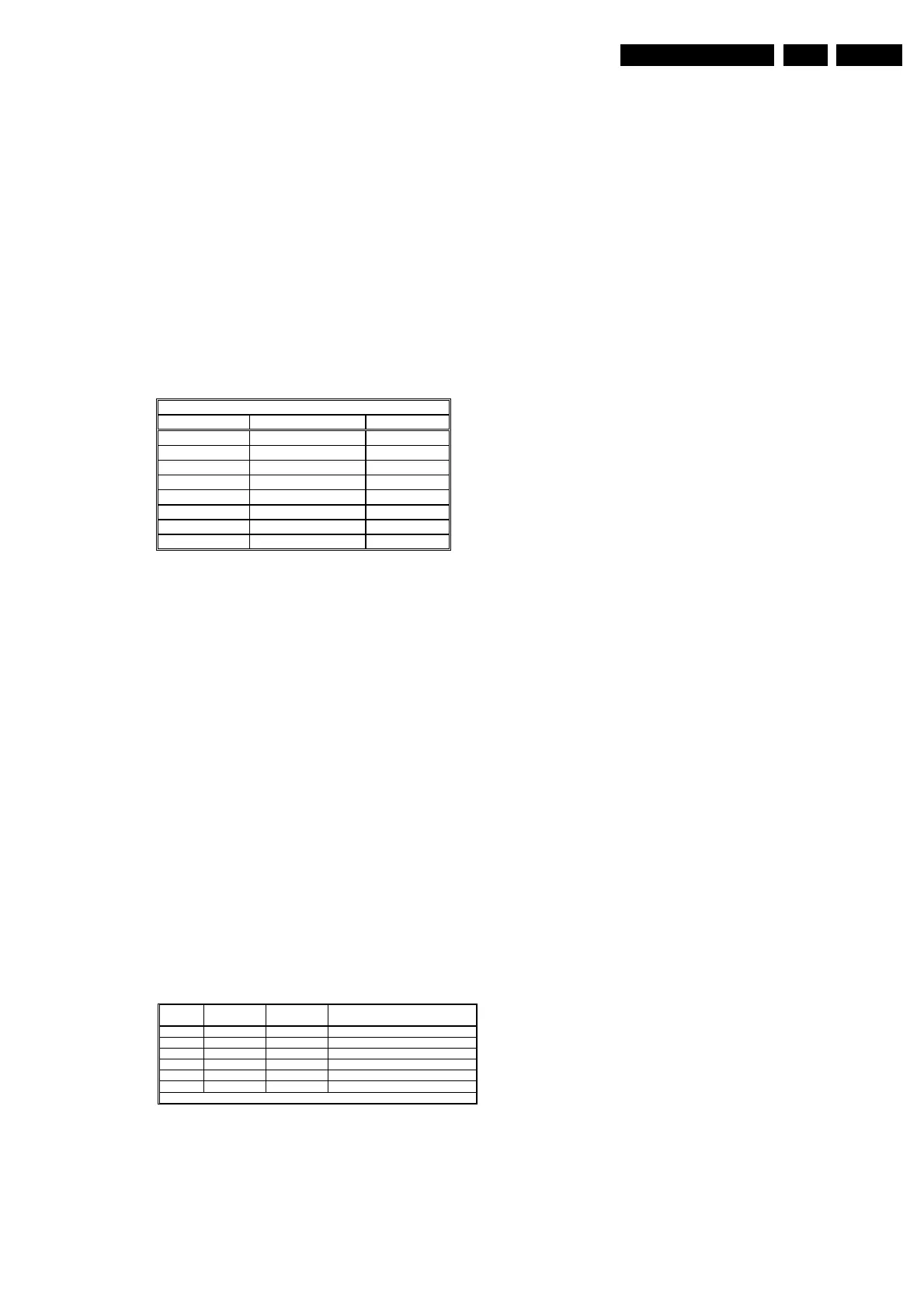
Figure 5-1
The numbering is in a logical sequence for diagnostics.
Always start diagnosing within a functional block in the
sequence of the relevant test points for that block.
Perform measurements under the following conditions:
• Service Default Mode.
• Video: colour bar signal.
• Audio: 3 kHz left, 1 kHz right.
5.2 Service Modes
Service Default Mode (SDM) and Service Alignment Mode
(SAM) offer several features for the service technician, while
the Customer Service Menu (CSM) is used for
communication between dealer and customer.
There is also the option of using ComPair, a hardware
interface between a computer (see requirements) and the TV
chassis. It offers the ability of structured trouble shooting,
error code reading and software version readout for all L01
chassis.
Minimum requirements: a 486 processor, Windows 3.1 and a
CD-ROM drive (see also paragraph 5.4).
Figure 5-2
5.2.1 Service Default Mode (SDM)
Purpose
• To create a predefined setting to get the same
measurement results as given in this manual.
• To override SW protections.
• To start the blinking LED procedure.
Specifications
• Tuning frequency:
– 475.25 MHz for PAL/SECAM (AP-PAL).
– 61.25 MHz (channel 3) for NTSC-sets (AP-NTSC).
• Colour system:
– PAL-BG for AP-PAL.
– NTSC for AP-NTSC.
• All picture settings at 50 % (brightness, colour contrast,
hue).
• Bass, treble and balance at 50 %; volume at 25 %.
• All service-unfriendly modes (if present) are disabled,
like:
– (sleep) timer,
– child/parental lock,
– blue mute,
– hotel/hospitality mode
– auto switch-off (when no ‘IDENT’ video signal is
received for 15 minutes),
– skip / blank of non-favorite presets / channels,
– auto store of personal presets,
– auto user menu time-out.
How to enter SDM
Use one of the following methods:
• Use a standard customer RC-transmitter and key in the
code ‘062596’ directly followed by the MENU button or
• Short wires 9631 and 9641 on the mono carrier (see Fig.
8-1) and apply AC power. Then press the power button
(remove the short after start-up). Caution: Entering SDM
by shorten wires 9631 and 9641 will override the +8V-
protection. Do this only for a short period. When doing
this, the service-technician must know exactly what he is
doing, as it could lead to damaging the set.
• Or via ComPair.
TEST POINT OVERVIEW L01
Test point Circuit Diagram
A1-A2-A3-…..
Audio processing A8, A9 / A11
C1-C2-C3-…..
Control A7
F1-F2-F3-…..
Frame drive A3
I1-I2-I3-…..
Tuner & IF A4
L1-L2-L3-….
Line drive A2
P1-P2-P3-…..
Power supply A1
S1-S2-S3-…..
Synchronisation A6
V1-V2-V3-…..
Video processing A5, B1
CL 16532008_044.eps
210501
6:
FOXVWHU
6:QDPH 82&W\SH 'LYHUVLW\
$3
$3
$3
$3
$3
$3
$EEUHYLDWLRQV$ $VLD3DFLILF& 176&1 QR7;77 7;7
CL 16532008_067.pdf
120601



 To Next Page