Need help?
Do you have a question about the POLMAR Shark and is the answer not in the manual?
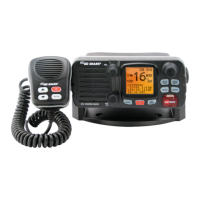
Overview of the base station radio, its power, DSC support, and key features.
Details specific requirements stipulated by ETSI for marine radio with DSC.
Identifies and describes the controls and buttons on the front panel of the base station.
Details the rear panel connections for antenna, power, external speaker, and GPS.
Describes the controls and functions of the handset unit.
Explains the various symbols and indicators displayed on the LCD screen.
Lists all accessories provided with the Shark radio for installation.
Provides guidance on selecting an optimal mounting location for the radio.
Details how to connect power supply, external speaker, and GPS equipment.
Step-by-step instructions for physically mounting the base station unit.
Guidelines for antenna mounting to ensure optimal performance and minimize exposure.
Instructions for mounting the handset hanger near the base station.
Explains how to transmit and receive, including power settings and PTT use.
Describes how to select different channels, including Channel 16 and INTL mode.
Details on selecting, saving, and deleting favorite channels in memory.
Explains the function and limits of the transmit time-out timer.
Instructions on how to use normal and memory scan modes.
How to activate and use Dual Watch and Tri-Watch modes.
Describes how the radio displays vessel position and time data from GPS.
Introduction to DSC, its purpose, and its role in maritime safety.
Explains what an MMSI is and its use in DSC calls.
Information on the process for obtaining an MMSI number.
Overview of different types of DSC calls that can be made.
Step-by-step guide on how to send a distress call.
Instructions for sending an All Ships Urgency or Safety call.
How to contact a specific group of vessels using DSC.
Process for making individual calls to other vessels.
Detailed steps for manually initiating an individual DSC call.
How to make an individual call using stored contact information.
How to acknowledge incoming individual DSC calls.
Recalling the most recent incoming call for follow-up.
Making calls using the recorded call log.
Functionality for requesting and replying with vessel position information.
General information on how the radio receives DSC calls.
How the radio handles an incoming distress call.
How the radio receives acknowledgments for distress calls.
How the radio handles distress calls relayed by another station.
How the radio receives All Ships calls.
How the radio receives group calls.
How the radio receives individual calls.
How the radio handles received position relay calls.
How the radio receives calls related to specific geographic areas.
Overview of the functions available within the setup menu.
Explains how to navigate and use the setup menu options.
Manages a list of frequently called DSC stations with names and MMSI.
Step-by-step guide to adding new contacts to the Buddy List.
Instructions for modifying existing entries in the Buddy List.
Process for removing contacts from the Buddy List.
How to adjust the screen backlight level.
How to adjust the screen contrast for readability.
Settings for GPS position and time display and manual entry.
Procedures for manually entering GPS data when it's not available.
Options for customizing GPS and time display formats.
Customization options for channel names, volumes, and speaker settings.
How to display and edit custom names for channels.
Adjusting the volume for incoming call ringtones.
Adjusting the volume for key press beeps.
Enabling or disabling the internal speaker.
Configuration settings for the DSC and ATIS functions.
Instructions for entering the unique user MMSI number.
Managing group MMSI numbers for group calls.
Setting automatic or manual responses for individual calls.
Option to temporarily disable or enable the DSC function.
Setting how the radio responds to position requests.
Resets all settings to factory defaults, excluding MMSI and Buddy List.
 General
| Brand | POLMAR |
|---|---|
| Model | Shark |
| Category | Transceiver |
| Language | English |


 To Next Page