Poseidon SE7EN+ User Manual Appendix 3 Page 95
Negative-Pressure Loop Test
Before powering-up the electronics, it is important to check the integrity of the breathing loop.
A positive-pressure loop test is conducted later on, as part of the normal power-up and auto-
mated pre-dive test procedure. However, it is possible that some leaks in the breathing loop
will fail only when the external ambient pressure exceeds the pressure inside the breathing
loop (and thus will not be detected during a positive-pressure loop test). For this reason, it is
important to conduct a manual negative-pressure loop test before starting a dive.
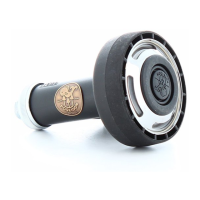
To conduct a manual negative-pressure loop test, rst secure the exhalation counterlung over-
pressure checkvalve by tightening it inward to its full extent using a clockwise rotation (when
viewed standing in front of the valve and looking at the valve). Place the mouthpiece switch
lever to closed-circuit (CC) position and inhale any residual gas within the breathing loop,
exhaling it through the nose to remove it from the breathing loop. Repeat this procedure several
times until you have pulled as strong a vacuum on the breathing loop as you can, and then
quickly switch the mouthpiece to OC position to hold the vacuum inside the breathing loop.
The breathing hoses will contract until no more breathing gas can be pulled from the loop.
IMPORTANT:
The functionality of a fully closed-circuit rebreather depends upon
an air-tight breathing loop. Do NOT dive the rig until it passes the
negative loop pressure test.
With the mouthpiece in the OC position, observe over a period of a two minutes whether the
breathing hoses expand from their contracted state, and the counterlungs show signs of
relaxing or inating slightly. If they do, then there is a leak somewhere in the breathing loop.
This could be caused by any number of reasons including but not limited to any of the
following:
• Improper hose connection (hose not connected or incompletely connected)
• Missing or failed o-ring in a hose connection or a Shoulder Port connection
• Tear in a counterlung or hose
• Failed overpressure checkvalve
• CO
2
cartridge lid not in place; or o-rings damaged or missing
• Mouthpiece o-rings damaged or missing
• Cracks into the O-rings for the E-module


 To Next Page