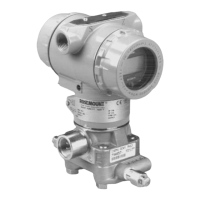
Rosemount Model 3095 Multivariable
™
Level Controller
2-16
ENVIRONMENTAL
CONSIDERATIONS
Mount the Level Controller to minimize ambient temperature changes.
Section 6: Level Controller Specifications and Reference Data
lists the Model 3095 temperature operating limits. Mount the Level
Controller to avoid vibration and mechanical shock, and to avoid
external contact with corrosive materials.
Access Requirements
When choosing an installation location and position, take into account
the need for access to the controller.
Process Flange Orientation The process flanges must be oriented so that process connections can be
made. In addition, consider the possible need for testing the controller.
CAUTION
Drain/vent valves must be oriented so that process fluid is directed
away from technicians when the valves are used.
Housing Rotation The electronics housing may be rotated to improve field access to the
two compartments. To rotate the housing less than 90 degrees, release
the housing rotation set screw and turn the housing not more than 90
degrees from the orientation shown in Figure 2-7 on page 2-11. To
rotate the housing more than 90 degrees, follow steps 1–6 of the
disassembly procedure on page 5-11.
CAUTION
Rotating the housing more than 90 degrees without performing the
disassembly procedure may damage the Level Controller sensor module.
Terminal Side of
Electronics Housing
Wiring connections are made through the conduit openings on the top
side of the Level Controller housing. The field terminal side is marked
on the housing.
Mount the Level Controller so that the terminal side is accessible.
A 0.75-inch clearance is required for cover removal.
Install a conduit plug on the unused side of the conduit opening.
Circuit Side of
Electronics Housing
The circuit compartment should not routinely need to be opened when
the unit is in service; however, provide 0.75 inches minimum clearance
if possible to allow access.


 To Next Page