

 To Next PageTo Next Page
 Need help?
Do you have a question about the Rotex RKHBH008AA and is the answer not in the manual?
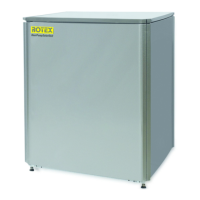
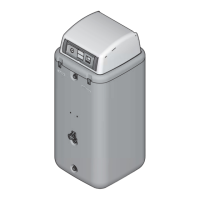
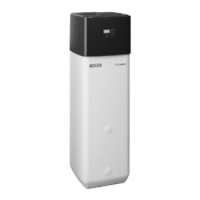
Provides an overview of the Rotex indoor unit and its compatibility with RRHQ heat pumps.
Outlines the procedures covered in the installation manual for RKHBH/X indoor units.
Explains the coding system for identifying Rotex indoor unit models.
Details the optional drain pan kit required for RKHBX models.
Lists the standard accessories provided with the indoor unit.
Illustrates space heating only with a room thermostat connected to the indoor unit.
Illustrates space heating with domestic hot water, without a room thermostat.
Explains pump operation and system control for heating/cooling based on thermostat input.
Details an application with a room thermostat for cooling/heating changeover.
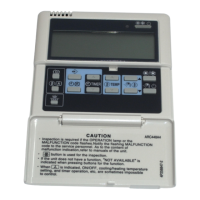
Describes how to access the unit's internal components and user interface.
Explains how the pump operates when no room thermostat is connected.
Provides detailed descriptions of each numbered component within the indoor unit.
Lists and describes the main electrical components within the switch box.
Shows the interconnection of major system components in a schematic diagram.
Specifies criteria for choosing a suitable indoor installation location.
Provides instructions for safely unpacking and handling the indoor unit.
Details the steps for securely mounting the indoor unit onto the wall bracket.
Instructions for installing the optional drain pan kit for cooling models.
Specifies the gas and liquid pipe connection sizes for indoor and outdoor units.
Outlines checks for the water circuit, including pressure and shut-off valves.
Explains how to calculate the correct expansion vessel pre-pressure based on height difference.
Details how to determine and verify the maximum water volume in the system.
Provides essential guidelines for connecting the water circuit to prevent damage and ensure proper function.
Step-by-step instructions for filling the unit with water and purging air.
Specifies requirements for insulating water circuit piping to prevent condensation.
Highlights essential safety precautions and requirements for field wiring.
Illustrates the required field wiring connections between system components.
Lists and explains the abbreviations for internal wiring components.
Details the power supply and communication cable requirements for the indoor unit.
Outlines the dedicated power circuit requirements for the backup heater.
Specifies power supply and contact voltage requirements for thermostats.
Provides wiring instructions for 2-way and 3-way control valves.
Explains how to connect to electricity company benefit rate power supply systems.
Describes the DIP switch settings for configuring unit functions.
Explains how to configure the unit when a room thermostat is connected.
Details pump operation settings with or without a room thermostat.
Describes the DIP switch setting for domestic hot water tank installation.
Advises on gradual heating to prevent floor cracking during initial start-up.
Lists essential checks to perform before powering on the unit.
Describes the initial power-up sequence and user interface display.
Explains how to adjust the pump speed based on system flow.
Introduces the concept of field settings for unit configuration.
Explains how to set user permission levels for the interface.
Details settings for automatic temperature adjustment based on outdoor conditions.
Describes settings for disinfecting the domestic hot water tank.
Explains the auto restart function after power loss.
Covers backup heater operation and space heating shut-off temperature settings.
Explains settings for restricting backup heater operation to low outdoor temperatures.
Details settings for prioritizing space heating over domestic hot water.
Defines temperature differences for starting/stopping domestic water heating.
Sets temperature difference for booster heater shut-off to prevent chattering.
Configures minimum/maximum heating times and anti-recycling time.
Defines limits for heating and cooling set points to prevent incorrect selection.
Provides a table of all field settings, default values, and ranges.
Defines which heaters are switched off based on benefit kWh rate signals.
Describes how to read software version, EEPROM, model ID, and temperatures.
Explains the automatic test run performed upon initial operation.
Details how to manually perform test runs for heating, cooling, and DHW.
Lists final checks to be performed after installation settings are complete.
Lists checks and inspections to be performed annually for optimal unit availability.
Provides general advice and precautions before troubleshooting.
Lists common unit symptoms and their possible causes and corrective actions.
Details error codes, their causes, and corrective actions.
Addresses low space heating capacity at low outdoor temperatures.
Lists general technical data including capacity, dimensions, weight, and connections.
Provides electrical data for the standard unit and backup heater.
Continues listing error codes and their corrective actions.
Lists general technical data including capacity, dimensions, weight, and connections.
Provides electrical data for the standard unit and backup heater.



 General