Need help?
Do you have a question about the Safe Fleet DH4C and is the answer not in the manual?
Outlines physical and environmental requirements for installing the DH4C DVR.
Step-by-step guide for physically installing the DVR unit and securing the SD card.
Instructions for connecting the optional adapter harness to the DVR.
Procedure for updating the DVR firmware using a USB memory device.
A checklist to ensure all hardware installation steps and checks are completed properly.
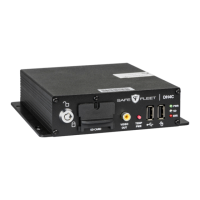
Describes the functions of the buttons, ports, and status lights on the DVR's front panel.
Details the connectors and ports located on the back panel of the DVR.
Explains how to interpret the DVR's status lights and indicators.
Describes how to flag important events in recorded video for easy review.
Guide on using the on-screen keyboard with a mouse for data entry in OSD fields.
Instructions on performing a health check for GPS, Ethernet, and Wi-Fi status.
Explains how to access the DVR's on-screen display menus for configuration and playback.
Details the information displayed during live camera viewing on the OSD.
Instructions for playing back, browsing, and copying recorded video clips.
How to use the DVR's search feature to find specific recorded events.
Procedures for accessing and configuring the DVR via on-screen menus or web browser.
Steps to set the correct time, date, and time zone for accurate indexing and playback.
How to configure display settings, including main title and metadata visibility.
Instructions for configuring individual camera settings like title, FPS, quality, and resolution.
How to set up and configure input signals for event triggering and labeling.
Steps to configure alarm events, including duration, quality, and resolution during alarms.
Method for creating and loading configuration files to manage multiple DVR setups.
Adjusting recording parameters like repeat record, delay timers, and secondary streams.
Configuring network connectivity for accessing the DVR remotely.
Settings for advanced network features, including VML and cellular modem connectivity.
Steps to configure the DVR's built-in Wi-Fi for network access.
Configuration and calibration of the G-Sensor for detecting impacts and movements.
Setting up speed limits and actions for excessive speed events.
Configuring geographical boundaries for location-based alerts.
Managing user access levels and passwords for DVR security.
Configuring system-wide settings like password protection and language.
Customizing camera feeds sent to the video output monitor.
Provides contact information for support and product details.
 General
| Brand | Safe Fleet |
|---|---|
| Model | DH4C |
| Category | Automobile Accessories |
| Language | English |

 To Next Page