SATEL-EASy+
User guide
Version 1.33
26
5.5 Serial data format
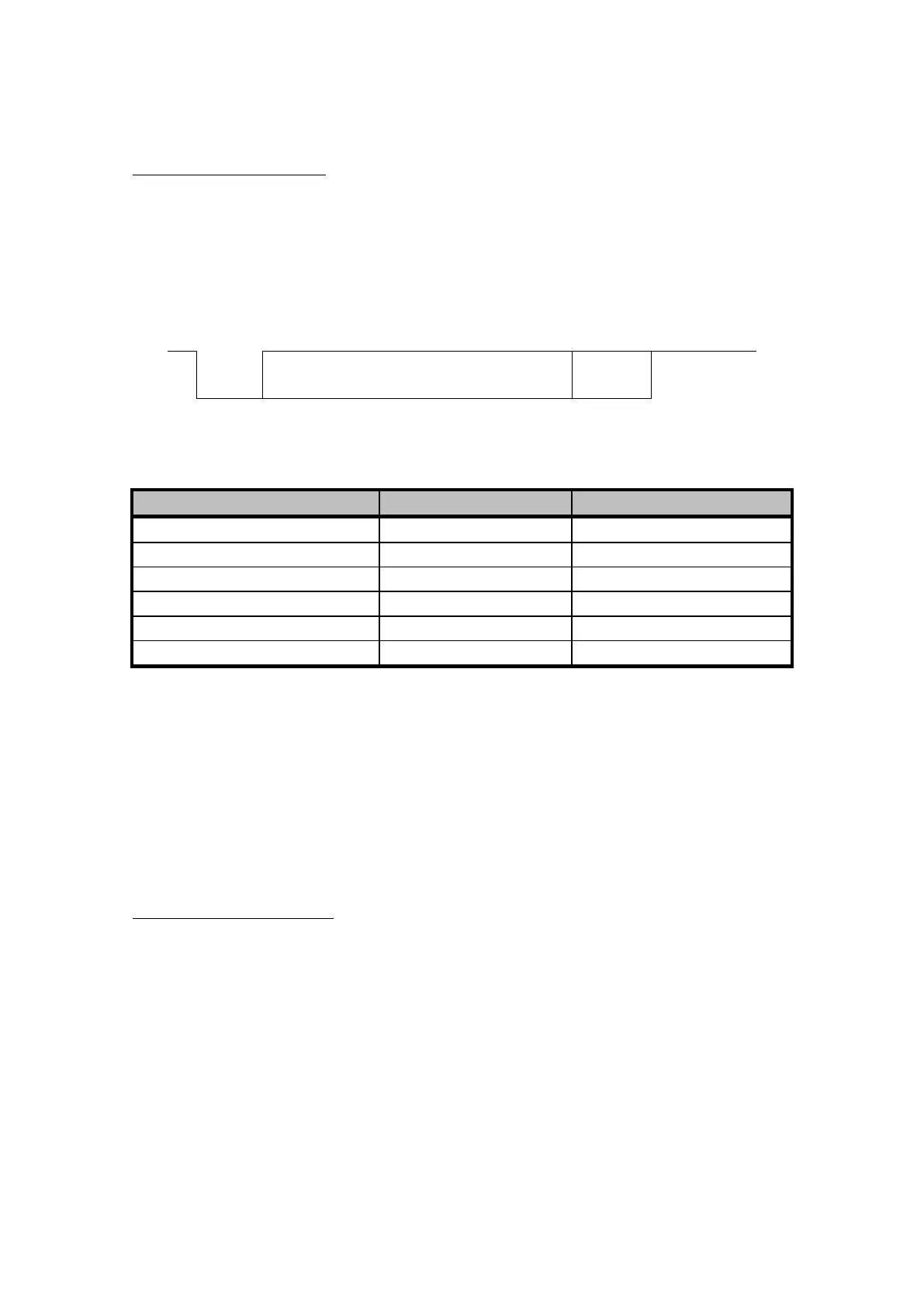
The serial interface uses an asynchronous data format. Any character to be transmitted on the
serial line contains a start bit, the data bits (7 or 8 bits), an optional parity bit and one or two
stop bits. Data bits are transmitted with the least significant bit first, the most significant bit last.
For even parity, the number of 1's in the data plus the parity bit equals an even number. For odd
parity, this sum is an odd number.
Data bits (lsb first, msb last)
Example: The letter C (43 in hexadecimal, 01000011 in binary) is transmitted as shown in the
table below when using 8-bit data length:
8 bits, no parity, 1 stop bit
8 bits, even parity, 1 stop bit
8 bits, odd parity, 1 stop bit
8 bits, no parity, 2 stop bits
8 bits, even parity, 2 stop bits
8 bits, odd parity, 2 stop bits
The overall length of characters (10, 11 or 12 bits) should be taken into account when
calculating the data throughput capability of a system. A useful rule of thumb is that the
transmission of one character will require roughly one millisecond (1ms) at 9600 bps.
The serial port settings of the radio modem and the terminal device connected to it must equal -
otherwise errors will be introduced into the transferred data.
5.6 Handshaking lines
Handshaking signals can be used to control data transfer. For example, the radio modem can
inform the DTE that the radio channel is busy, and that it is not allowed to initiate transmission.
A common way of using handshaking signals is to monitor the CTS-line and ignore the others.
Usually, the terminal device is fast enough to handle the data received by the radio modem, so
the use of RTS-line is not necessary.


 To Next Page