SATEL INTEGRA Plus 5
The master code should not be used on a daily basis because of the risk of its being
captured. It is recommended that the administrator enter for himself an ordinary user's
code.
4.3 Operation under duress
When acting under duress, the DURESS type code must be used instead of the normal user
code (see “User types” p. 25).
5. Operating the alarm system by means of LCD keypad
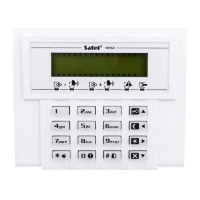
SATEL offers the following keypads for INTEGRA Plus control panels:
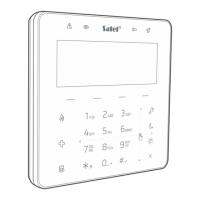
INT-TSG – touchscreen keypad,
INT-TSI – touchscreen keypad,
INT-TSH – touchscreen keypad,
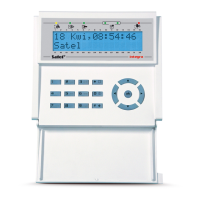
INT-KSG – LCD keypad with touch keys,
INT-KLCD – LCD keypad with mechanical keys,
INT-KLCDR – LCD keypad with mechanical keys and built-in proximity card reader,
INT-KLCDK – LCD keypad with mechanical keys,
INT-KLCDL – LCD keypad with mechanical keys,
INT-KLCDS – LCD keypad with mechanical keys,
INT-KLFR – LCD keypad with mechanical keys and built-in proximity card reader.
The keypads are available in a variety of color options for the enclosure, display and key
backlight. The color variant is indicated by the additional designation in the keypad name
(e.g. INT-KLCD-GR – green display and key backlight; INT-KLCD-BL – blue display and key
backlight).
5.1 Keypads description
The INT-TSG, INT-TSH, INT-TSI and INT-KSG keypads are described in separate
manuals, which are delivered with these keypads.
5.1.1 LCD display
The display facilitates communication between the user and the alarm system, clearly
indicating the system status. The functions available to the user are presented on the display.
The display backlight can be used, if needed.
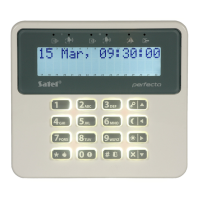
In standby mode, the display shows:
– in the upper line – the date and time in the format defined by the installer,
– in the lower line – the keypad name or state (status) of selected partitions (to be defined
by the installer).
The installer can configure the keypad so that when you press the 9 key for approx. 3
seconds, the display will enter the partition state presentation mode. The status of
partitions operated by the keypad (including those from which alarm is signaled on the
keypad) is presented by means of symbols. The display will return to the standby mode after
you press the 9 key for approx. 3 seconds again.
If some predefined events occur, additional messages may appear on the display (e.g.
arming, disarming, auto-arm delay countdown, entry/exit delay countdown, alarm, etc.).



 To Next Page