Page 38 of 58
4.0 Optical System Preparation
In order to perform multiphoton imaging with the detection modules, it is necessary to prepare laser beam
delivery and scanner optics.
4.1 Transmission Viewing
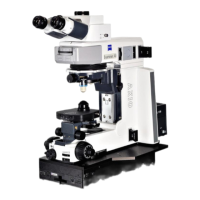
For best image quality, we recommend using Köhler illumination. The intermediate diffuser within the
SliceScope’s substage optics should be removed from the beam (the silver lever at the lower left side of the
SliceScope should be moved to the horizontal position).
For slice samples, it is convenient to use near IR transmission illumination as it is capable of penetrating a
sample and giving clear images when viewed with a suitable camera. In this case, the laser / visible dichroic
mirror(s) in the detection module(s) can be left in beam without problems – they will transmit the NIR
illumination.
If you want to use visible light for viewing, then the laser / visible dichroic mirrors must be moved out of the
beam to permit the illumination to reach the sample and the eyepieces or camera.
It is possible to arrange auxiliary contrast techniques (such as Dodt contrast) at the rear of the SliceScope. If
you are using a MOC variant, then it is possible to use DIC (along with a suitable condenser and analyser).
DIC will however spread the laser intensity out slightly, reducing multiphoton resolution and efficiency.
4.2 Transmitted Laser Imaging
If the microscope is set up for Köhler illumination, then near IR laser radiation transmitted by a slice sample
will pass through the condenser and emerge at the rear of the SliceScope. It is possible to arrange a photo-
diode detector in this area (possibly viewing via an auxiliary contrast system) to collect the signal whilst
multiphoton imaging is in progress, and to generate a transmission reference image.
4.3 Laser Beam Delivery
A good scanner system uses auxiliary optics to image one scanner mirror (X) onto the other (Y), and then to
image these both onto the rear aperture of the objective lens. This scheme ensures maximum efficiency and
scanning speed and prevents vignetting The dimensioned drawings in the appendix show the nominal heights
of the objective lenses in each variant of the system as fitted to a SliceScope onto which the beam delivery
optics should focus the scanner mirrors. Note that the beam delivery system should have the ability to
accommodate some focus adjustment.
The system should also provide some means of expanding the laser beam so that it will fill the rear aperture of
the objective; this is important
for achieving both high multiphoton fluorescence efficiency and for achieving high resolution.
Other features that you may wish to consider as part of the wider optical system include
A safety shutter that occludes the laser beam until you are ready to acquire an image.
A method of varying the intensity of the laser beam delivered to the sample (for example a polarisation
rotation system with a polarising beam-splitter cube and a beam dump).



 To Next Page