Copyright © Shimmer 2017
Realtime Technologies Ltd Shimmer User Manual
All rights reserved Rev3p
49
6. Hardware
This section provides an overview of the Shimmer hardware architecture and discusses the hardware
sub-systems contained within. For Shimmer3 mainboard detail, debug and testing procedures and
pin-out information, please refer to the Appendices of this document.
6.1. Shimmer Hardware Overview
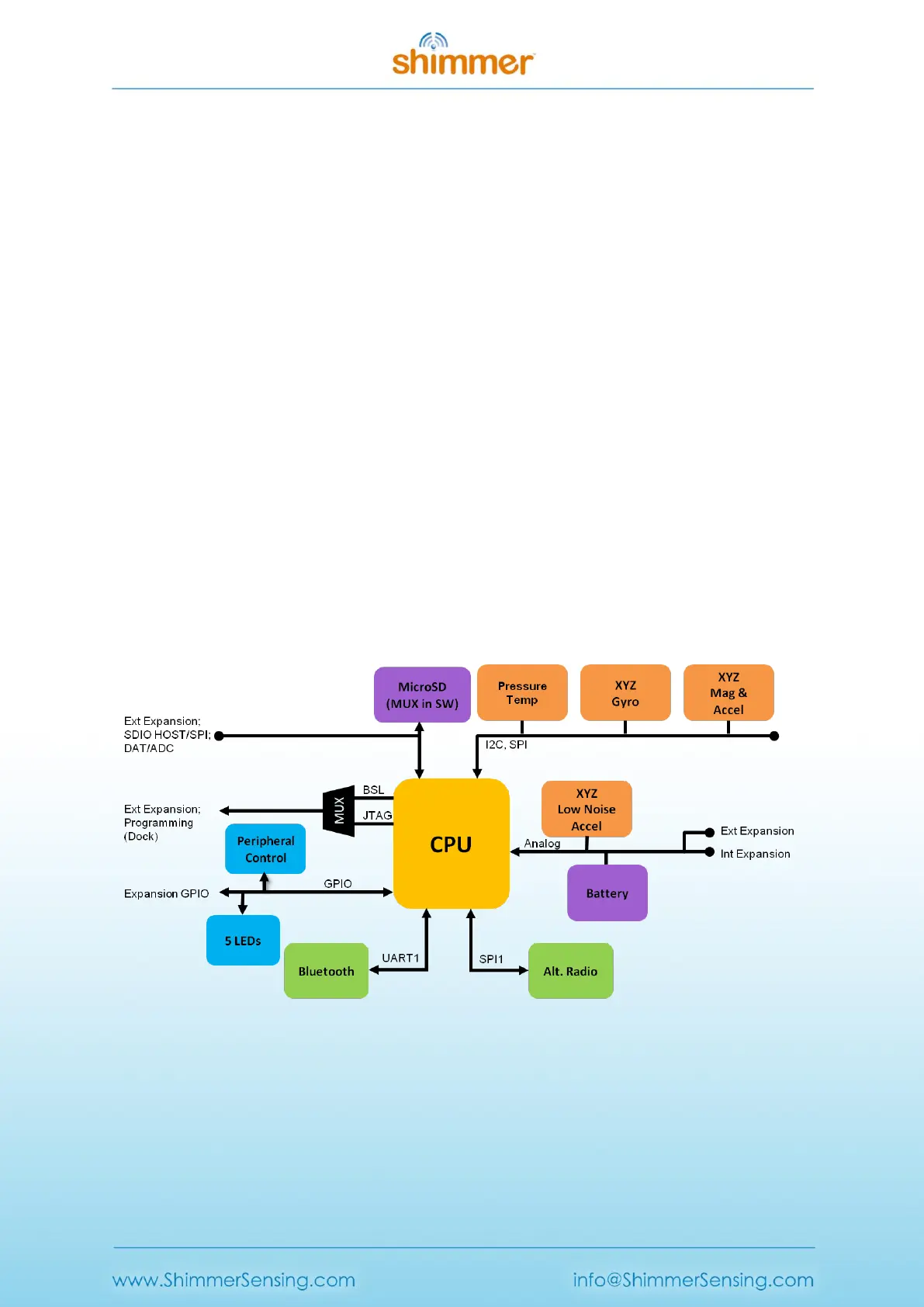
Figure 6-1 presents a block diagram of the Shimmer3 mainboard with core components and
interconnections between integrated devices illustrated.
The central element of the platform is the low-power MSP430F5437A microprocessor which controls
the operation of the device. Nearly every feature of the CPU is exercised in the Shimmer
implementation. The CPU configures and controls various integrated peripherals through I/O pins,
some of which are available on the internal/external-expansion connectors. The CPU has an
integrated 16-channel 12bit analogue-to-digital converter (ADC) which is used to capture sensor
data from the low noise accelerometer, battery, or sensor expansions, such as GSR, Bridge Amp and
Proto 3 Deluxe. The external expansion also allows communication to and from the mainboard using
the docking station.
The Shimmer board has a built in microSD Flash socket for additional storage and has five light-
emitting diodes (LED) for display purposes. It also has an on-off switch and a software-defined user
button. For wireless data streaming, the platform is equipped with a Bluetooth radio module and
has the capacity for an additional alternative radio.
Figure 6-1 Shimmer3 Core Component Block Diagram
6.2. Hardware Sub-System Detail
Functional descriptions of communication, microSD storage and power subsystems are presented in
this section. For the purposes of debug and testing, lower level component information can be found
in the appendices of this document. Vendor datasheets and application notes are the best sources of


 To Next Page