37
9. AT (Auto-tuning)
In order to decide each value of P, I, D and ARW automatically, the auto-tuning process should be
made to fluctuate to obtain an optimal value.
One of 3 types of fluctuation below is automatically selected.
For DC input, the AT process will fluctuate around the SV for conditions of (A), (B) and (C).
Sometimes the auto-tuning process will not fluctuate if auto-tuning is performed at or near room
temperature. Therefore auto-tuning might not finish normally.
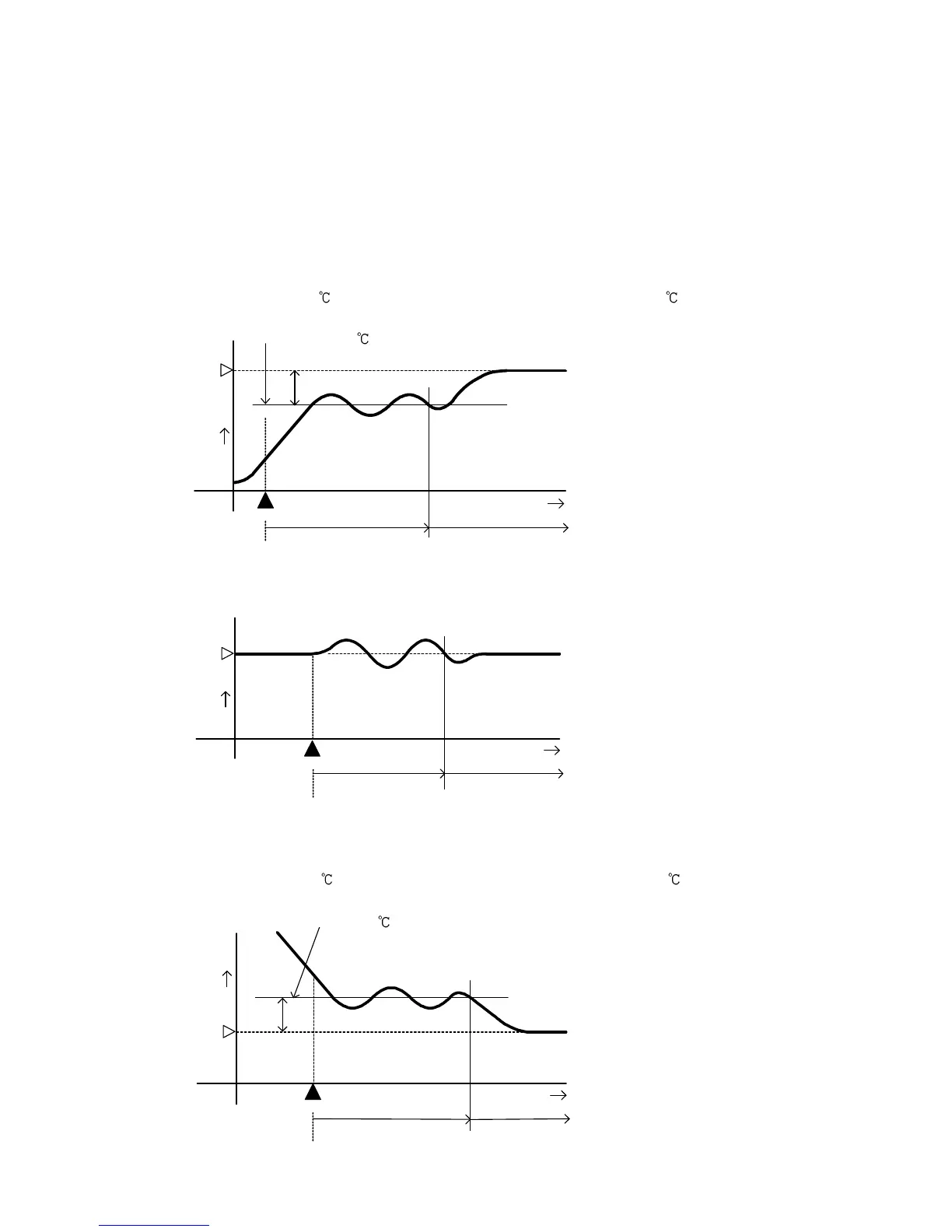
(A) In the case of a large difference between the SV and processing temperature as the
temperature is rising
When AT bias is set to 20 , the AT process will fluctuate at temperatures 20 lower than the SV.
Temperature 20 lower than the SV
(1) Calculating PID constant
(2) PID constant calculated
(3) Controlled by the PID
constant set by auto-tuning
(4) AT bias value
(B) When control is stable
The AT process will fluctuate around the SV.
(1) Calculating PID constant
(2) PID constant calculated
(3) Controlled by the PID
constant set by auto-tuning
(C) In the case of a large difference between the SV and processing temperature as the
temperature is falling
When AT bias is set to 20 , the AT process will fluctuate at temperatures 20 higher than the SV.
Temperature 20 higher than the SV
(1) Calculating PID constant
(2) PID constant calculated
(3) Controlled by the PID
constant set by auto-tuning
(4) AT bias value
(1)
(2) (3)
(4)
AT starting point
SV
Temperature
Time
AT starting point
(1)
(2)
(3)
Temperature
SV
Time
AT starting point
(1)
(2)
(3)
(4)
Temperature
SV
Time



 To Next Page