40
69
You can sew seams easily and accurately when you follow
the suggestions below.
Preparing a seam
Starting
a seam
Starting
a
seam
Keeping seams straight
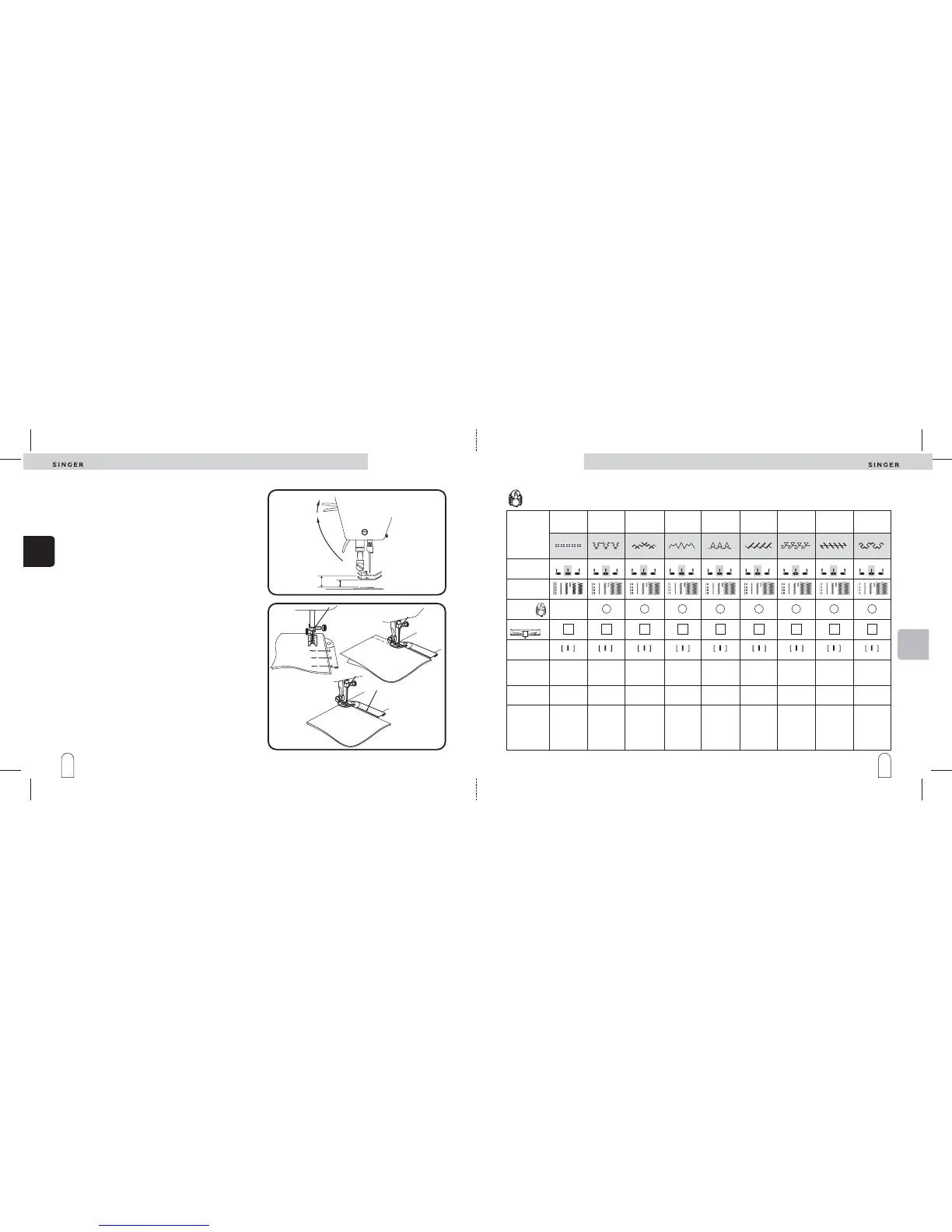
To keep seams straight, use one of the guidelines on the
needle plate.
• The most commonly used line (1), the 5/8 inch (1.6 cm)
seam allowance, is extended onto the slide plate.
Basting
The Basting stitch produce long stitches that can be easily
removed. A few of the many sewing jobs for which you will
find Basting particularly useful are joining seams, marking
construction guidelines, hems and seams.
Use for making the Basting stitches a fast speed, stitch
length at Basting position and little needle thread tension.
Placing fabric under foot
Most fabrics can be placed under the foot by raising the
pesser foot lifter (1) to its normal “Up” position (2), where
it locks in place.
When using bulky fabric, multiple fabric layers or an
embroidery hoop, raise the lifter to the high rise position
(3), thus increasing the space between the foot and the
needle plate.
• Lower presser foot lifter all the way down and you are
ready to sew.
3
2
1
3
2
1
1
Sélecteur
Application
Longueur
de point
Pied
presseur
Plaque à
aiguille
POINT
Position
d'aiguille
Largeur
de point
A
Tout
Módules
A
2
2
2
2
22 2
2
2 2
2
BCD EFGH
A
SpécialSpécialUniversel Spécial Spécial Spécial Spécial Spécial Spécial
Univer-
selle
Univer-
selle
Univer-
selle
Univer-
selle
Univer-
selle
Univer-
selle
Univer-
selle
Univer-
selle
Univer-
selle
Module 2 - Points extensibles
Assemblage
des
tissus
extensibles
Décoration Décoration Décoration Décoration
Point
frivolité
Point
en croix
Point
double
renfort
Point
de sapin
Point droit
extensible
Point
overlock
renfort
Point
de milan
Point
vous et
moi
Point
château
Surfilage
et
couture
Décoration
Assemblage
bord à bord
Décoration
Couture
droite,
zig-zag et
autres points
Couture
droite,
zig-zag
et
autres
points


 To Next Page