¾ Safety Sides (Swivelling)
Risk of Injury
If elevated special mattresses are used (for prevention or therapy), e.g. mattresses to prevent
pressure sores, then an effective safety side height of at least 22 cm above the non-occupied
mattress must be guaranteed.
If this requirement is not met, the operator is responsible for taking any additional measures, or
other measures he considers suitable, based on his own risk assessment in view of the clinical
condition of the patient, such as additional safety systems for the patient, regular and more fre-
quent monitoring of the patient or internal instructions for the users.
The patients risk of falling can be lower:
the smaller and calmer the patient is
the softer the mattress is (patient sinks deeper).
Risk of Crushing
When the safety sides are raised, the electric adjustment of the backrest and thigh rest must be
locked:
the patient is unable to operate the bed safely
the patient is unable to free himself from potentially dangerous situations
If there is an increased risk of entrapment for the patient when adjusting the backrest and
thigh rest if the safety sides are raised
Otherwise there is a danger of the patient's limbs being crushed or trapped between the
safety sides if the patient inadvertently activates the handset. The effectiveness of the safety
sides can also be reduced if the mattress base is raised to a high level.
9.10.1 Raising
The following section describes how to raise the safe-
ty sides on one side of the bed. The safety sides on
the other side of the bed are raised in exactly the
same way.
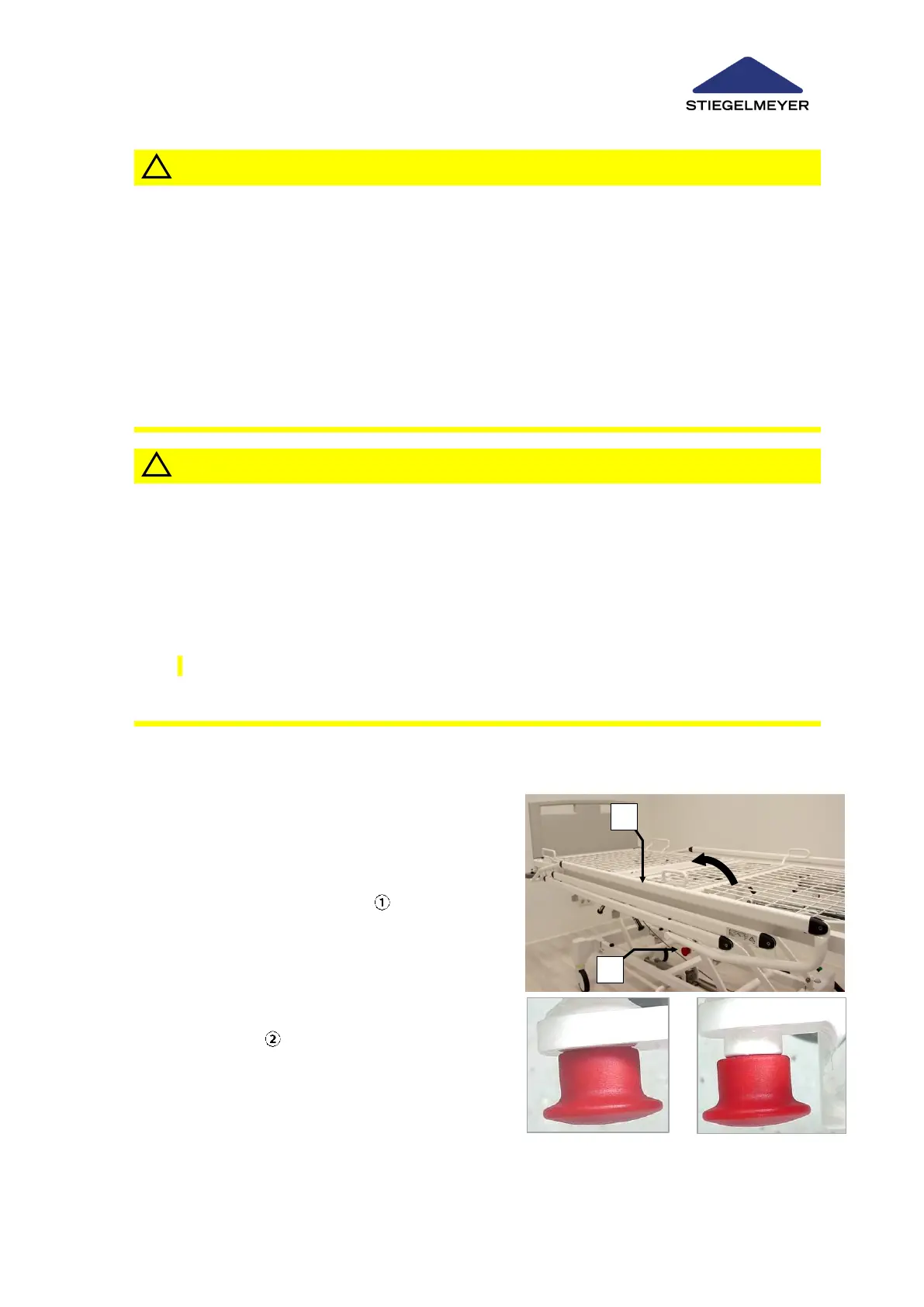
1. Grasp the top rail of the safety side with one hand.
2. Swivel the rail upwards as far as it will go towards the
head end of the bed.
This raises the entire safety side.
The safety side must audibly click into place and the
red release button must not protrude downwards!
3. Check that the safety side is securely fixed in place by
pushing and pulling the top rail from one end to the
other!
4. Repeat the procedure for the
other safety side.


 To Next Page