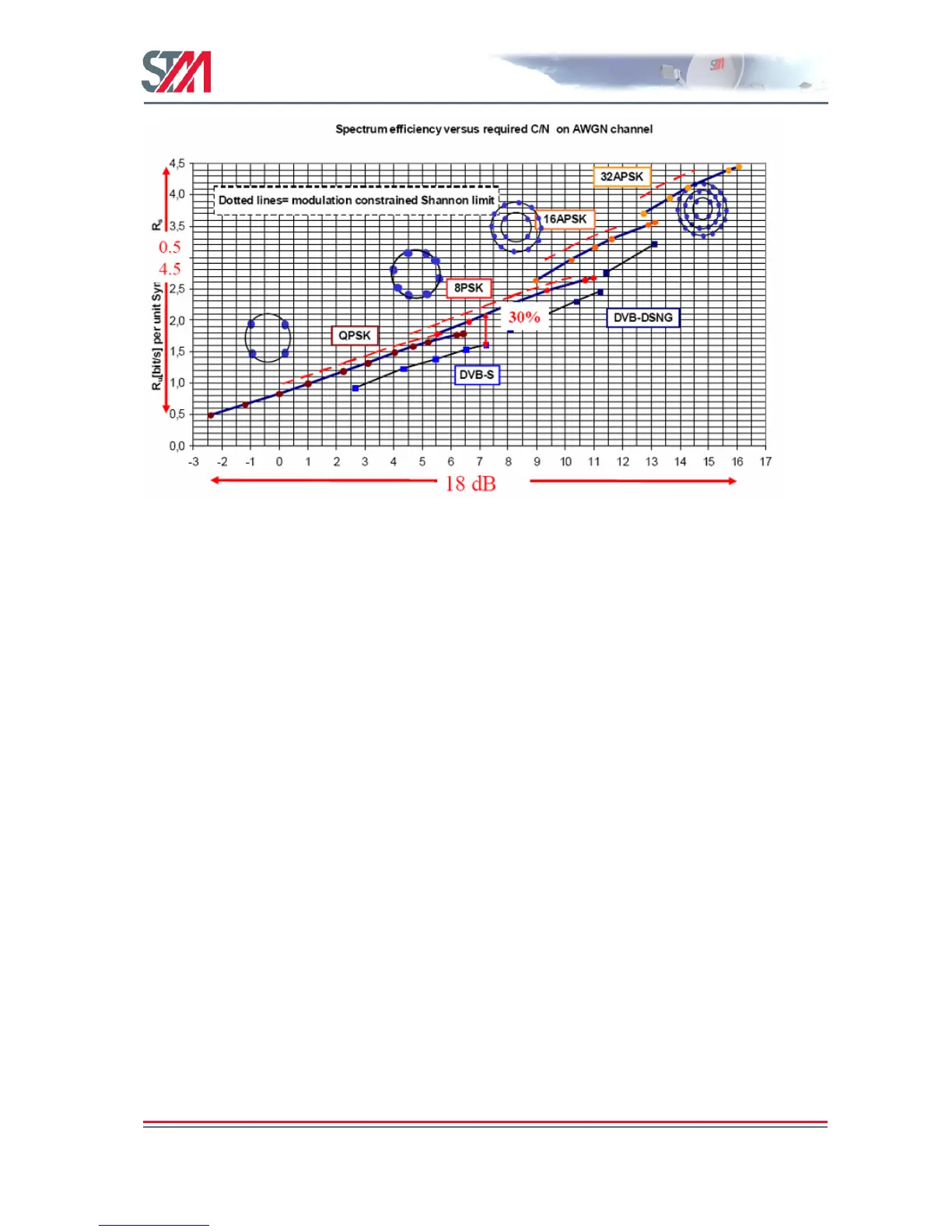
Figure 39: DVB-S2 Coding Performance
17.3 DVB-S2 Coding and Modulation Control Modes
Depending on the network configuration, the SatLink IDU may be operated with fixed, variable, or
adaptive coding and modulation mode, denoted as CCM mode, VCM mode, and ACM mode,
respectively. In CCM mode, the same code/modulation combination, denoted as MODCOD, is used all
the time and for all VSATs. The MODCOD is determined through engineering by considering the system
parameters (e.g., satellite EIRP, VSAT G/T, antenna sizes, coverage, etc.) and the environmental
conditions in the region of the network, combined with link availability requirements, using standard link
budget techniques. In VCM mode, a different coding and modulation may be used for different VSATs,
for example, based on their geographic position in the beam, their availability requirement, and/or their
antenna size.
In ACM mode, however, the MODCOD may be changed dynamically for each VSAT, from one FEC
frame to the next. Hence, the applied MODCOD can be adapted to the near instantaneous and individual
link conditions of each VSAT in order to maximize the attainable information rate per Hz of bandwidth
for the network as a whole (i.e., aggregate bandwidth efficiency), while meeting required link
availabilities across the network at all times.
In the SatLink system, this is accomplished by each VSAT constantly measuring its received signal-to-
noise ratio (SNR) and reporting it periodically to the SatLink Hub. The Hub then uses the SNR value
reported from each VSAT at a given time to select the suitable MODCOD for each. All signaling
information is always transmitted at the lowest MODCOD with the best link margin in order to ensure
that all VSATs are able to receive it.


 To Next Page