EasyManua.ls Logo

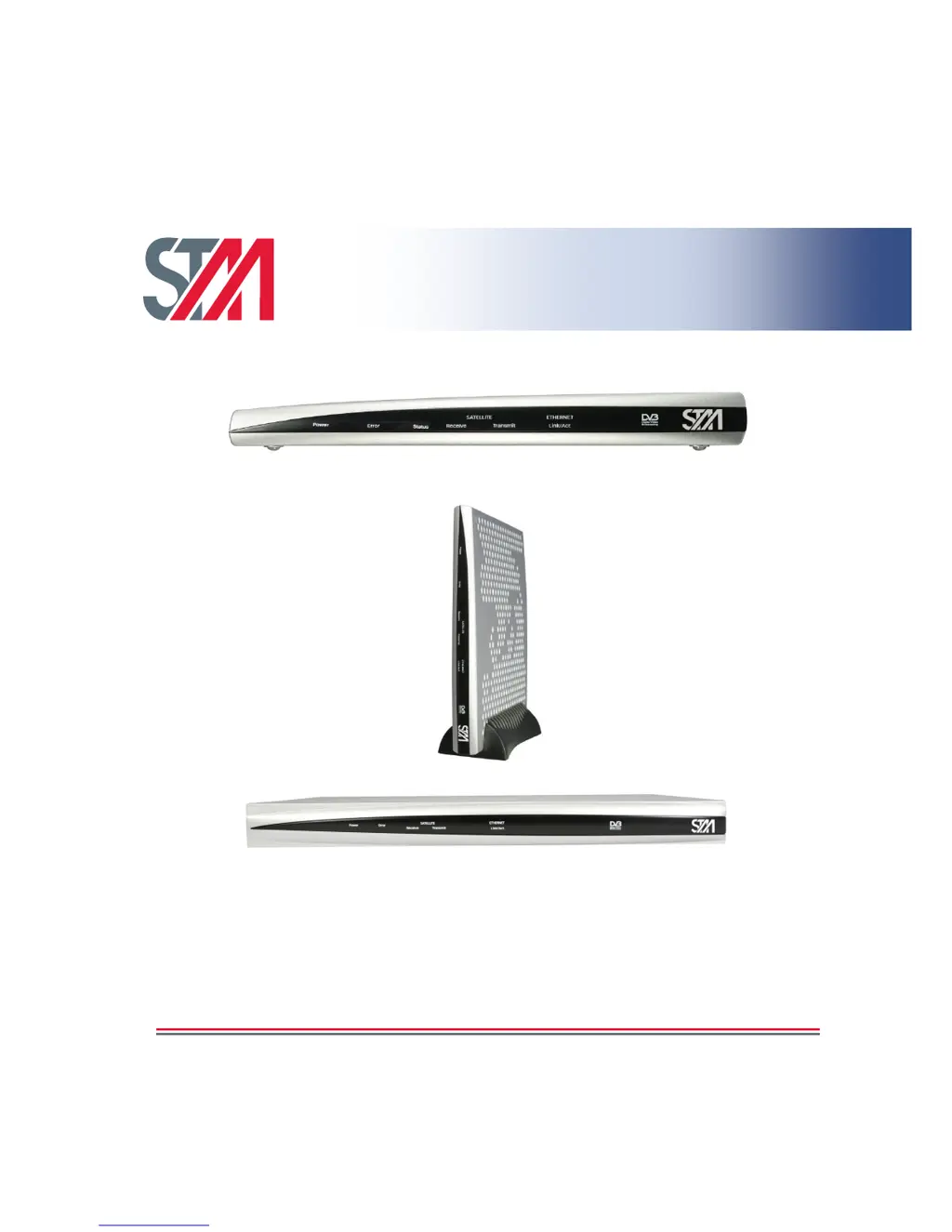
STM SatLink VSAT - User Manual

STM SatLink VSAT
183 pages
Print Icon
To Next Page IconTo Next Page
Loading...
SatLink VSAT User Guide
User Guide
Revision 14.1.1-2 January 12
th
2012
Networks without Barriers

Table of Contents

Questions and Answers

  • M
    Mark HaydenAug 15, 2025
    What to do if STM Receiver displays 'Sync Max Loss Exceeded - Logging off'?
    • D
      Danielle ClarkAug 15, 2025
      If the STM Receiver shows 'Sync Max Loss Exceeded - Logging off', it means the VSAT has sent the maximum allowed number of synchronization messages to the Hub without a response. Check the power level and antenna.
  • A
    Ashley HeathAug 18, 2025
    Why STM Receiver shows 'Logon Failed -- Hub busy'?
    • S
      Scott CarterAug 18, 2025
      The 'Logon Failed -- Hub busy' message on your STM Receiver indicates that the Hub has insufficient resources to serve the logon request from the VSAT. If this continues to happen, there may be something wrong with the VSAT configuration at the Hub side.
  • J
    Julia MedinaAug 22, 2025
    What does 'Logon Denied' mean on STM Receiver?
    • M
      Melissa PowellAug 22, 2025
      If your STM Receiver displays 'Logon Denied', it means the VSAT is not authorized to log on to the satellite network. Please contact the Hub Operator.
  • N
    Nichole JonesAug 26, 2025
    What to do if STM Receiver VSAT displays 'Receiver tuning failed for …'?
    • M
      Mallory CooleyAug 26, 2025
      If the STM Receiver VSAT displays 'Receiver tuning failed for …', it indicates that the VSAT is missing all or part of the information in the signal transmitted from the DVB-RCS Hub. Verify that the receiver status is 'locked' using the command DVB RX SHOW.
  • J
    Jessica PatrickAug 28, 2025
    What to do if STM Receiver VSAT displays 'Logging on- Logon failed'?
    • J
      Jessica WalkerAug 28, 2025
      If the STM Receiver VSAT displays 'Logging on- Logon failed' after line up has been performed and levels calibrated with Control Center, verify that the GPS configuration is correct.
  • D
    Derek MaloneSep 1, 2025
    Why is the input from keyboard not displayed on STM Receiver screen?
    • R
      Roberta SalazarSep 1, 2025
      If the input from the keyboard is not displayed on the STM Receiver screen, but information from the VSAT is visible, verify that the Local Echo is enabled in the Telnet Client.
  • D
    Dylan MorrisSep 4, 2025
    What to do if STM Receiver displays 'Rx tuning failed for RMT TS (from NIT)'?
    • M
      Matthew KnoxSep 4, 2025
      If the STM Receiver displays 'Rx tuning failed for RMT TS (from NIT)' it means that the secondary transponder signaled from the Hub cannot be found. Please contact Hub Operator for assistance, because this could be a possible configuration error at Hub, or temporary outage.
  • B
    Blake WrightSep 7, 2025
    What to do if STM Receiver displays 'RMT not received'?
    • W
      William VelasquezSep 7, 2025
      If the STM Receiver displays 'RMT not received' it means that the RCST cannot find a valid RCS Map Table. This is probably due to the RMT missing, or due to a missing linkage descriptor of type 129 (RCS FLS Service) with an appropriate population ID. Please contact Hub Operator for assistance.
  • M
    matthew71Sep 12, 2025
    What to do if STM Receiver displays 'NIT not received'?
    • C
      craig21Sep 12, 2025
      If the STM Receiver displays 'NIT not received' it means that the RCST cannot find a valid Network Information Table. Check that NIT is not missing and the linkage descriptor of type 7 (RCS Map Service) is also available.

Summary

Installation Procedures

Connecting a PC to the SatLink VSAT

Windows 7 TCP;IP Configuration

Guides on setting up TCP/IP for PCs connected to the VSAT LAN in Windows 7.

Using the SatLink VSAT Web Interface

SatLink VSAT Configuration and Line-up via Web Interface

Logging On to the VSAT Web Interface

Describes the process of accessing the VSAT's web interface with login credentials.

VSAT Parameter Configuration for Hub Logon

Details configuring essential VSAT parameters like satellite, IP, and positioning.

Line-up Procedures Using the Web Interface

Covers antenna alignment, TX power calibration, and BUC line-up steps.

Testing the Connection to the Hub

Outlines steps to verify the VSAT's connection status with the network Hub.

Preparing the VSAT for Normal Operation

Final configuration steps to ensure the VSAT is ready for regular network use.

Status Monitoring via SatLink Web Interface

Satellite Interface Status Details

Provides an overview of the satellite interface state, transmitter, and receiver status.

Using the Command Line Interface (CLI)

Summary of Available CLI Commands

Provides a reference list of CLI commands available in boot and application SW.

VSAT Configuration and Line-up via CLI

Powering On and Logging On via CLI

Steps for powering on the VSAT and logging into the CLI for configuration.

Initial Configuration Parameters via CLI

Details configuring antenna, ODU, geographical position, and forward link parameters.

VSAT Line-up Procedures via CLI

Covers forward link acquisition, TX power calibration, and antenna adjustments.

Testing Connection to the Hub via CLI

Steps to verify the VSAT's connectivity to the network Hub.

Network Address Translation (NAT) Configuration

Configuring Dynamic NAPT

Explains how to set up dynamic NAPT for LAN-initiated connections over satellite.

Quality of Service (QoS) Configuration

Configuring QoS for the Return Link

Explains how to use a multi-field classifier for IP packet QoS grouping.

Traffic Initiated Logon Configuration

Header Compression Settings

Updating the VSAT Software (SW)

Automatic Software Update Procedure

Explains how the VSAT can receive software updates automatically from the SatLink Hub.

Manual Software Update Process

Guides on manually upgrading VSAT software using the `sw upgrade` command.

SatLink and DVB-S2 Features

Software Options and Licensing

TCP Performance Enhancing Proxy (PEP-TCP)

Explains PEP-TCP for improving TCP performance over satellite links.

Extensions for Mobile VSATs

Transmit Inhibit Functionality

Describes implementing a transmit inhibit function for safety compliance.

Mobile VSAT LAN Interface to Antenna Controller

Covers configuring the antenna controller, BUC, LNB, and forward link entries.

Mesh VSATs Operation

Appendix A: Accessing the CLI via Serial Console Port

Appendix D: Testing VSAT Network Connectivity

Ping Function for Network Diagnostics

Explains how to use the ping command to test network communication and latency.

Appendix E: Management via SNMP

Appendix F: ODU Installation Procedures

Appendix H: Manual Configuration of VSAT Parameters

Manual IP Address Configuration

Provides CLI steps to manually set LAN and DVB interface IP addresses.

Appendix I: IDU Power Calibration & P1 dB Configuration

Calibrating the IDU Output Power

Step-by-step guide to calibrate TX output power using 3rd party BUCs.

Appendix K: Troubleshooting VSAT Issues

Troubleshooting Q&A

Common questions and answers for resolving VSAT operational problems.

Debugging Network Connections

Using ping and other tools to diagnose network connectivity issues.

List of Common VSAT Events and Comments

Details common events logged by the VSAT, their severity, and required actions.

Appendix N: Receiver and Transmitter Autostart Configuration

STM SatLink VSAT Specifications

General IconGeneral
Frequency Range950 - 2150 MHz
Input Level-65 to -25dBm
Power Supply100-240VAC, 50/60Hz
LNB Supply Voltage13/18VDC
Symbol Rate Range1 - 45 Msps
Roll-off Factor0.20, 0.25, 0.35
Input Impedance75 Ohm
Data InterfaceEthernet
DemodulationQPSK, 8PSK, 16APSK, 32APSK
Output InterfaceEthernet
Operating Temperature0 to +50 °C