WARNINGS AND SAFETY PRECAUTIONS
4 MJB4 - Warnings and Safety Rev02 01-06
1
ing, min/max power, service life), lamp explosions
during operation are extremely rare.
The exposure lamp should always be protected
against shock when handling - the lamps should al-
ways be stored and transported in their original
packaging!
Any other mechanical stress such as bending or
twisting during installation should also be carefully
avoided!
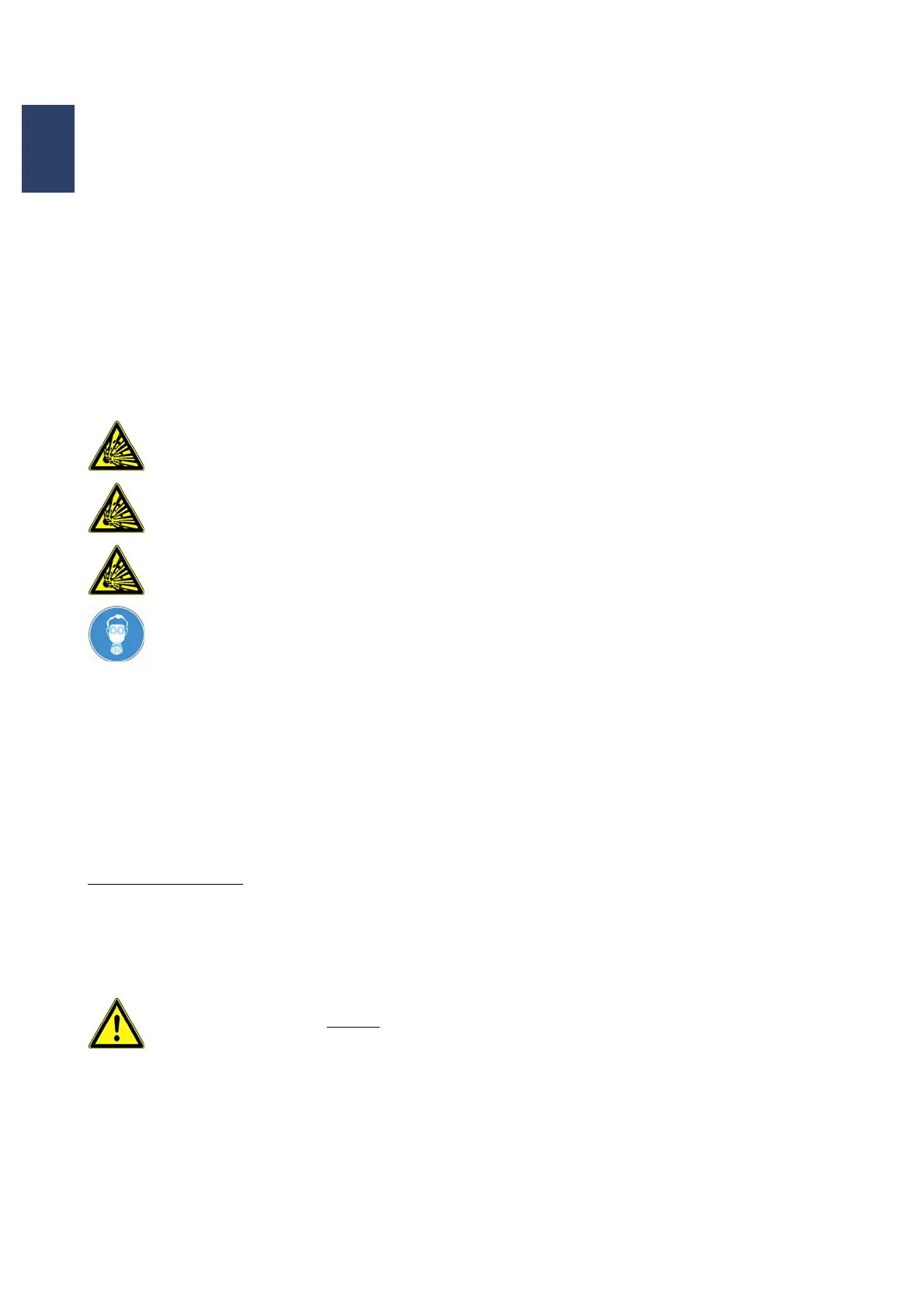
The exposure lamp is under high pres-
sure.
Mechanical face and eye protection
should be worn when handling a high-
pressure lamp!
If the lamp breaks, do not touch the
components with the hand and do not
inhale the Hg fumes!
Use a breathing mask with gas absorp-
tion during decontamination!
In the event of a lamp explosion, after the immediate
measures described in section Danger of poisoning
an Hg decontamination kit (e.g Mercurisorb) should
be used to eliminate the mercury which is still
present. Such a kit should always be kept in store.
These can be obtained, for example, from:
Carl Roth GmbH & Co
P.O. Box 100121
D-76231 Karlsruhe
http://www.carl-roth.de
1.6.1.2. Changing the Lamp
Only use lamps of a type approved for use by SUSS
MicroTec Lithography!
In almost all exposure lamps, the anode
(positive pole) is at the bottom
.
Only the 500W DUV Hg/Xe lamp (Ushio)
position is reversed.
After changing the lamp type or replac-
ing a CIC1200, CPC200 or CPC350 it is
essential to check the correct polarity
of the lamp and correct type selection
on the CIC1200 before switching on the
lamp!
Always follow the lamp manufacturer's directions!
When fitting or removing the lamp, avoid any me-
chanical load acting on the glass tube! Only tighten
the lamp by hand!
Pay attention to the correct handling of different
lamp mountings (depending on the lamp house
type) - see Servicing section in the manual!
Connect the connection contacts on the lamp in
such a way that electrical contact resistances are
minimized. Replace all components which show
traces of corrosion or overheating!
1.6.1.3. Setting Regulations for Lamp
Cooling
The UV-exposure lamps must be cooled in a con-
trolled way in order to maintain safe and optimum
operating conditions. The cooling should be set up
individually according to the lamp type.
Detailed values for the lamp cooling and the vol-
ume flow which needs to be extracted for differ-
ent lamps can be found in the table "Setting
values for lamp cooling and lamp house extrac-
tion" in section 1.1. "Prerequisites for Installa-
tion".
The basic components of the cooling are:
• Blowing of nitrogen onto the metallic lamp cap
(but never the glass tube),
• Blowing of compressed air into a heat sink (for ra-
diation of heat) in the lamp house.
The lamp-specific values both for the adjustment of
the blowing of nitrogen onto the upper and lower
lamp caps and also for the extraction should be ob-
served.
Significant deviations from the setting values endan-
ger your safety!
Minor deviations affect the operating safety of the
lamp and machine.
If a lamp frequently illuminates in an unstable man-
ner, or of the life of the lamp has systematically de-
teriorated, carefully check the settings for the lamp
cooling. Frequently, the cause of such problems lies
in incorrect setting of these data or in incorrect fixing
of the connections. If you are not sure, call in SUSS



 To Next Page