20220323 Swegon reserves the right to alter specications.
35
WISE User Manual
Control of the fan coil
Why control a fan coil?
To prevent two separate systems for heating and cooling coun-
teracting each other.
How is a fan coil controlled?
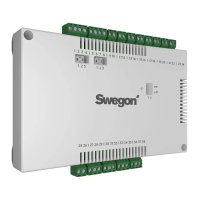
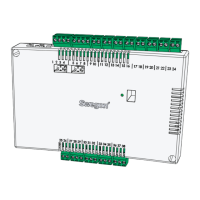
WISE supports dierent types of fan coil integration with the help
of WISE IORE, but this is limited to fan coils with the following
functions:
- The fan speed must be possible to control with a - V
signal
- Water valves according to one of the following options:
. Two water valves, heating and cooling, of the typeV
on/o
. One water valve, heating or cooling, of the typeV on/o
. One water valve, only cooling, of the type - V
- Condensation monitoring with open/closed signal
WISE supports two variants of fan coil control:
. Parallel control of the fan and water, without the possibility
of the user controlling the fan speed
. Separate control of the fan and water, with the possibility
of the user controlling the fan speed
A description of how these two variants work is given below.
Parallel control of the fan and water
In this case WISE RTA can be used to let the user control the
temperature set point in the room. Control of the fan coil occurs
via WISE IORE. Two outputs are used to control the water valves
(one for cooling and one for heating) and one output controls
the fan speed. Air and water are regulated in parallel where the
fan speed is proportional to the water valve’s degree of opening.
The fan speed increases/decreases to the same extent as the
water valve’s degree of opening. In order to attain the right fan
speed, settings for voltage must be made to satisfy the lowest
and highest possible fan speeds. When the speed signal is 0%
the voltage signal is 0V to stop the fan.
Operating case
In the cooling instance:
Cooling requirement > 0% = Fan starts and the cooling valve
starts to open. The fan speed and the valve’s degree of opening
increases as the cooling requirement in the room increases. For a
reduced need, the fan speed and degree of opening on the cooling
valve decreases until the need = 0%. The fan then stops. The oppo-
site occurs for a congured heating function.
Separate control of the fan and water
In this case WISE RTA can be used to let the user control both
the temperature set point and the fan speed in the room. As
standard the fan speed is set to AUTO, and the fan speed is then
controlled in parallel with the water valve, as described under
Parallel control of the fan and water. In addition to AUTO, there
are four other manual settings that the user can set for the fan
speed:
- Speed: the fan is turned o
- Speed: The fan speed is set to the congured speed,
standard %
- Speed: The fan speed is set to the congured speed,
standard %
- Speed: The fan speed is set to the congured speed,
standard %
When the user sets the fan speed manually, it returns to AUTO
aer a specic time. This time can be congured and if it is set
to 0 the function is disabled, which means the setting automati-
cally switches to AUTO.
Operating case
In the cooling instance:
Cooling requirement > 0% = Cooling valve starts to open. The
valve’s degree of opening increases as the cooling requirement
in the room increases. The fan speed and degree of opening on
the cooling valve decreases with a reduced requirement until
the requirement = 0%. The fan then stops. The fan speed is
controlled according to the setting on WISE RTA. The opposite
occurs for a congured heating function.
Fan coils oen have a lter and it is possible to set a life expec-
tancy for the lter. An alarm is activated when the active time
reaches the life expectancy. Setting the alarm time to 0 disa-
bles this alarm function. The user can reset the active time, this
should be done once the lter has been cleaned. The time when
the fan speed is set to 0 is not included in the active time. The
active time is saved and is not aected in the event of a restart.
Fan coils can also have condensation monitoring, an alarm is
activated if the condensate reaches a high level in the inner
container. All cold water is stopped when the alarm is active in
an attempt to prevent more water from accumulating.
Control of chilled ceilings
Why control a chilled ceiling?
To prevent two separate systems for heating and cooling coun-
teracting each other.
How is a chilled ceiling controlled?
WISE supports integration of dierent types of chilled ceilings,
both for cooling and heating, with the help of WISE IORE:
- Chilled ceiling in two or four tube systems, with or without
central change over
- Chilled ceiling with Swegon’s CCO valves or third-party
six-way valve



 To Next Page