Swegon reserves the right to alter specications. 20220323
32
WISE User Manual
Control of solar shading
Why control solar shading?
A good level of air quality and a thermal climate that maintains
a certain level adapted to the activities in the premises are
required for the indoor climate to be perceived as comfortable.
The natural light that enters a room through windows is likely
to provide much of the well-being factor. Large windows have
been popular in recent decades, but a key factor in that context
is that solar radiation can deliver a valuable volume of energy
to an interior, especially in south-facing aspects over the spring
and autumn.
With the WISE system it’s not only the ventilation and indoor
climate that is controlled, it’s also possible to control interior sun
shading as required in the premises. Solar shading can be used
as part of temperature control, harnessing solar radiation to
heat the room or, conversely, shutting it out to cool the room.
Solar shading can be used as insulation, to prevent heat from
escaping through windows during the night if it's cold outdoors.
It can also be used as glare protection, to prevent those in the
room being disturbed by the light. It’s also possible to control the
solar shading manually via push buttons. Each room is connec-
ted to a façade, and information about the sun’s brightness is
obtained from a weather station.
How does solar shading control work?
WISE supports control of internal solar shading with analogue
controlled motors with two positions: open or closed.
Solar shading can be controlled to provide insulation from the
cold, as a heat shield or to prevent those remaining in the building
being dazzled by sunlight. In order to have a working system, a
WISE Director must be connected to a WISE WS weather station
to provide current values about the sun, such as direction, height
and brightness. These are needed to gure out which façades
have sun and which do not. Six façades can be congured, where
each façade has a name, start and stop angles and height. If the
position of the sun is within a façade and is above the congura-
ble brightness limit, that façade is considered to have sun. When
controlling solar shading, there are several operating modes that
can be set as needed, including Schedule, glare protection and
insulation. Solar shading can be controlled to two positions: open
or closed.
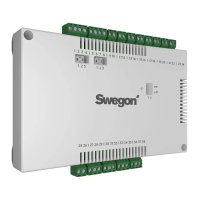
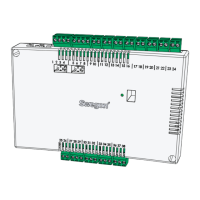
WISE IORE is used together with two relays connected to the solar
shading’s motor. A momentary push button for overriding can be
connected to WISE IORE or WISE IRE.
To congure a working system, the following must be set up:
• The brightness of the sun, which is the brightness at which
the system judges that the sun is shining. In all probability
this needs to be evaluated when operational to discover
which setting works best with the local conditions for the
project in question.
• Direction, which is the direction of the façade in degrees
from north.
• Minimum height of the sun for the façade to be considered
sunny.
• Start and stop angles, how many degrees from the direction
of the façade the sun is considered to reach, i.e. which is not
shaded. This must be set for each façade.
Operating modes
The dierent operating modes can overlap and interact. For
example, glare protection can be used during occupancy while
insulation is used only when unoccupied, combined with the user
having the possibility to override via a push button.
Schedule and override button
Rooms can have their solar shading controlled up or down via
a schedule. The schedule has the highest priority, overridden
only by an override button. The override button shall be of the
monostable type. When used, the shades close or open depen-
ding on where they were before the user pressed the button, and
always run to the opposite position. The shades return to being
controlled automatically by either: pressing the button once
more or with a congurable timer elapsing. If the timer elapses
while the room is still occupied, the shades will remain in over-
ride mode until the room becomes unoccupied.
Glare protection
It’s possible to activate glare protection, which is used to prevent
the occupants of the building being dazzled by sunlight. If glare
protection is activated, the solar shading will be closed at all
times when the sun is shining on the façade in question and the
room is occupied. However, if glare protection is not activated,
the solar shading will only close when the cooling load exceeds
the set limit.
As insulation
Solar shading can be used for dierent types of insulation: On,
O or Only unoccupied.
When on, the solar shading actively tries to help achieve the
temperature setpoint for the room. This means that it closes
as a heat eld or to insulate depending on whether the sun is
shining on the façade in question or not and whether there is a
need of heating or cooling in the room. For example, the solar
shading will open to let in sunlight if there is a need of heating
in the room and, conversely, close if there is a need of cooling in
the room.
When o, the solar shading will ignore the temperature requi-
rements of the room and will not open or close to aect the
temperature of the room.
When set to Only unoccupied, the solar shading will only
act on the temperature requirement when the room is not in
occupancy mode.
Minimum sun
height
Façade with solar
shading
Start angle
Stop angle
Façade with
solar shading
Façade
direction
Façade settings



 To Next Page