Glossary GL-5
IDE Intelligent drive electronics. Refers to the solid-state hard drive
type.
IEC International Electrotechnical Commission. This international
agency regulates laser safety by specifying various laser operation
classes based on power output during operation.
IEC (825) Class 1 This is the lowest power IEC laser classification. Conformity is
ensured through a software restriction of 120 seconds of laser
operation within any 1000 second window and an automatic laser
shutdown if the scanner's oscillating mirror fails.
IEEE Address See MAC Address.
Interleaved 2 of 5 A binary bar code symbology representing character pairs in groups
of five bars and five interleaved spaces. Interleaving provides for
greater information density. The location of wide elements (bar/
spaces) within each group determines which characters are
encoded. This continuous code type uses no intercharacter
spaces. Only numeric (0 to 9) and START/STOP characters may
be encoded.
Intercharacter Gap The space between two adjacent bar code characters in a discrete
code.
Interleaved Bar Code A bar code in which characters are paired together, using bars to
represent the first character and the intervening spaces to
represent the second.
Interleaved 2 of 5 A binary bar code symbology representing character pairs in groups
of five bars and five interleaved spaces. Interleaving provides for
greater information density. The location of wide elements (bar/
spaces) within each group determines which characters are
encoded. This continuous code type uses no intercharacter spaces.
Only numeric (0 to 9) and START/STOP characters may be encoded.
Internet Protocol Address See IP.
I/O Ports interface The connection between two devices, defined by common
physical characteristics, signal characteristics, and signal
meanings. Types of interfaces include RS-232 and PCMCIA.
Input/Output Ports I/O ports are primarily dedicated to passing information into or out
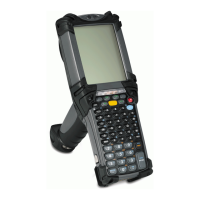
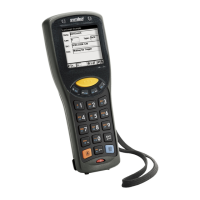
of the mobile computer’s memory. MC1000 mobile computers
include Serial and USB ports.
IP Internet Protocol. The IP part of the TCP/IP communications
protocol. IP implements the network layer (layer 3) of the protocol,
which contains a network address and is used to route a message
to a different network or subnetwork. IP accepts “packets” from the
layer 4 transport protocol (TCP or UDP), adds its own header to it
and delivers a “datagram” to the layer 2 data link protocol. It may
also break the packet into fragments to support the maximum
transmission unit (MTU) of the network.
IP Address (Internet Protocol address) The address of a computer attached to
an IP network. Every client and server station must have a unique IP
address. A 32-bit address used by a computer on a IP network.
Client workstations have either a permanent address or one that is
dynamically assigned to them each session. IP addresses are
written as four sets of numbers separated by periods; for example,
204.171.64.2.


 To Next Page