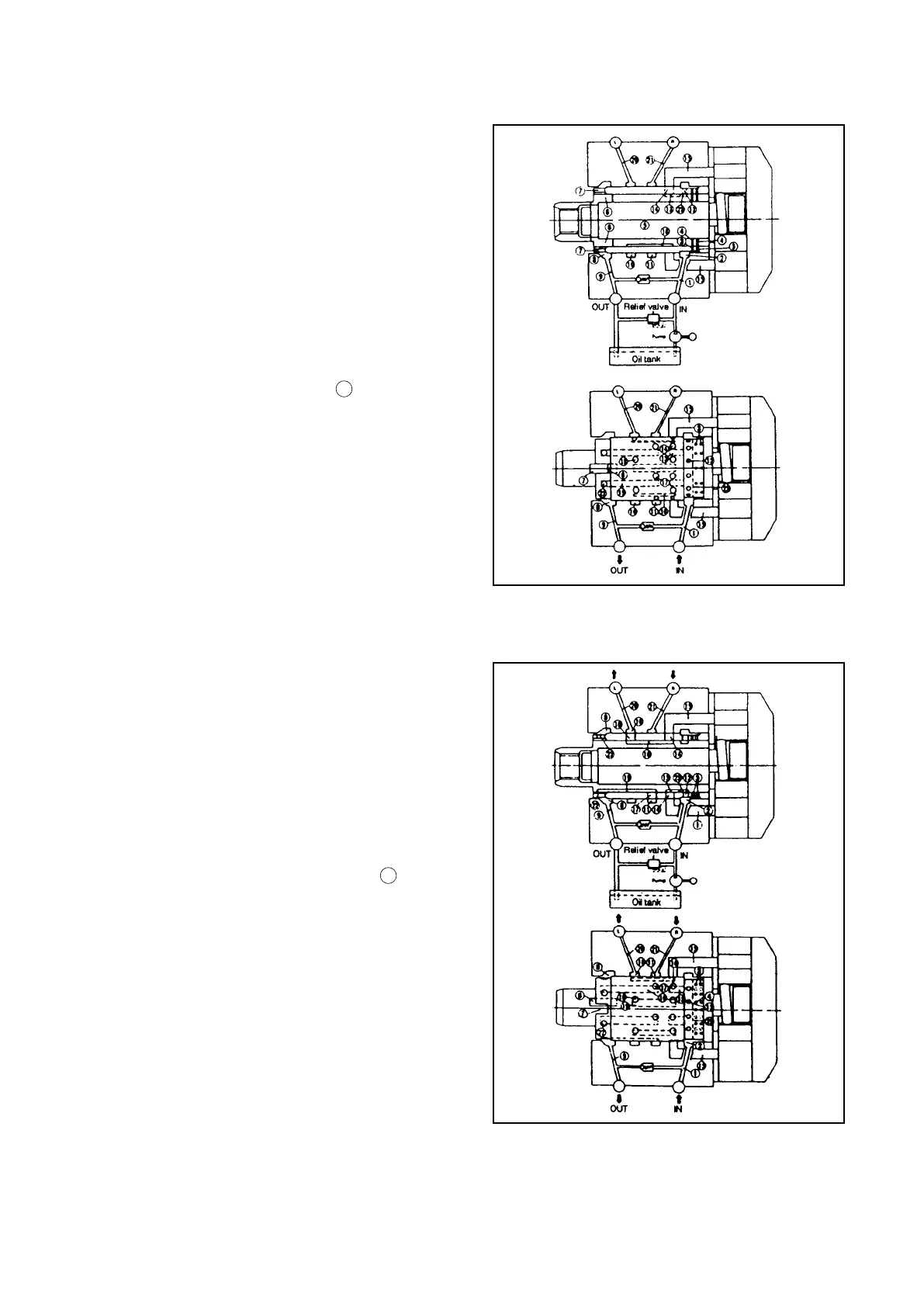
(1) Operation of orbitrol
(a) In “Neutral”
While the steering wheel is in straight
position, the oil from the pump ows through oil
passage ① to oil groove ② . The sleeve has 24
oil holes ③ which are now in line with the holes
④ in the spool so that the oil that flowed into
groove ② passes through oil holes ③ and ④ to
space ⑤ between the spool and drive shaft. Then
the oil ows through spool groove ⑥ and sleeve
groove ⑦ back to the oil tank.
Since cylinder ports ⑳ and
21
are respectively
open to oil holes ⑱ and ⑰ in the sleeve but not
to groove ⑯ nor ⑲ in the spool, the oil in the
cylinder does not go any where.
Oil passage ⑮ that leads to the hydraulic motor
is open to oil hole ⑭ in the sleeve which is used
as the inlet and outlet for the hydraulic motor, but
not to grooves ⑬ nor ⑯ in the spool and thus the
oil remain unmoved.
(b) When steering wheel is turned counterclock-
wise
As the steering wheel is turned counterclock-
wise, the grooves in the spool shift to the left in
relation with the holes and grooves in the sleeve
so that holes ④ in the spool get out of line with
holes ③ in the sleeve. The oil that has owed into
groove ② thus far begins to ow into hole ⑫ in
the sleeve, passing through grooves
23
and ⑬ in
the spool, hole ⑭ in the sleeve, and oil passage
⑮ in the housing, to the hydraulic motor.
The hydraulic motor thus rotates in the
counterclockwise direction and the oil discharged
from the hydraulic motor ows through oil hole
⑭ in the sleeve, groove ⑯ in the spool, and oil
hole ⑱ in the sleeve to the cylinder port L in the
housing and thus actuates the steering cylinder.
Fig. 6A.8
Fig. 6A.9
6A. STEERING SYSTEM (ORBITROL type)



 To Next Page