26
Tempest900 2-Channel Operating Manual
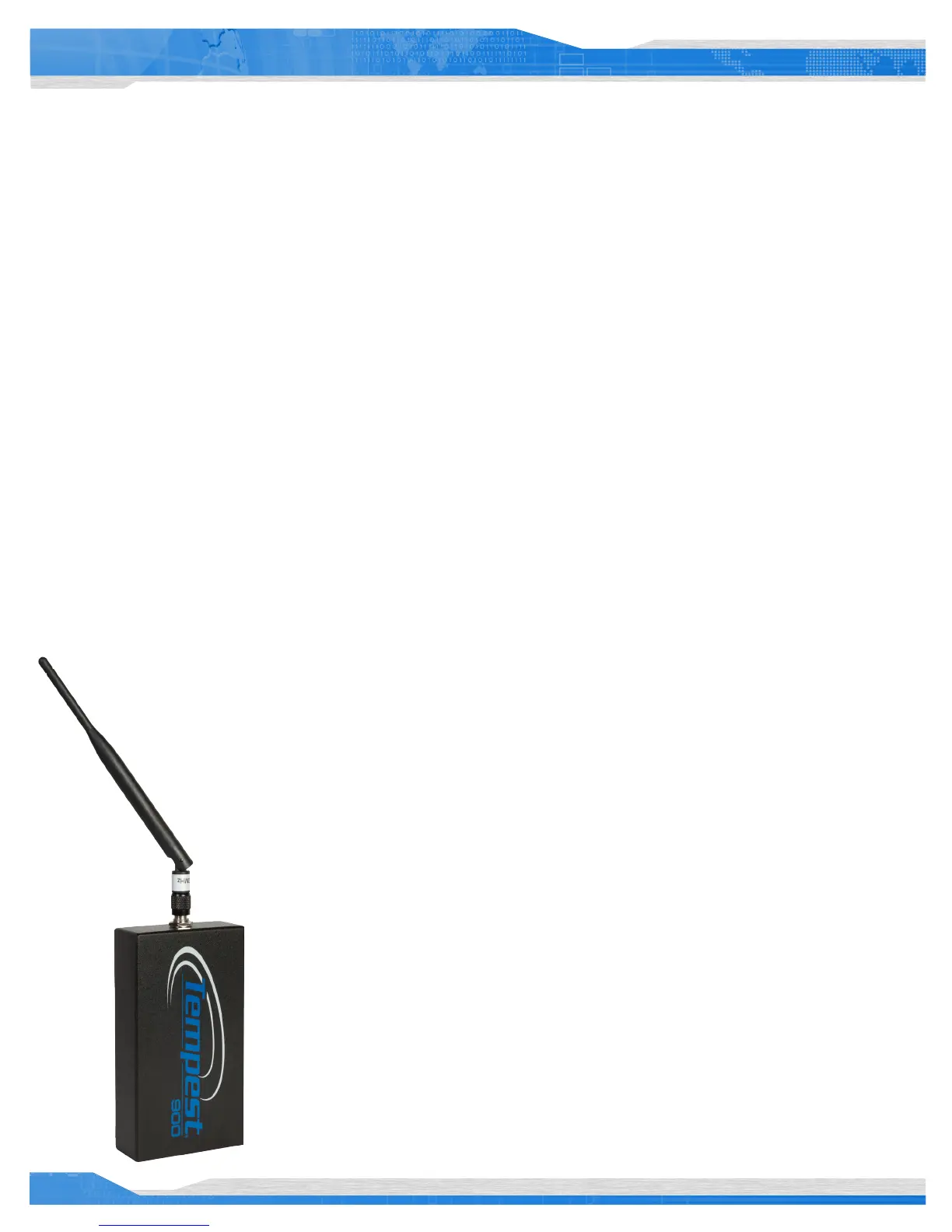
Remote Transceiver
Set Up the Transceiver
• Choose a BaseStation location.
• Choose a Transceiver location.
• Choose an antenna conguration.
• Install CAT-5 cable and connect to the BaseStation and Transceiver.
• Conrm operation by observing the Transceiver LEDs.
The Tempest Remote Transceiver is an optional accessory that allows antennas to be located up to 1,500 feet away from the BaseStation
without the RF signal loss that is associated with using long runs of coaxial cable.
The Tempest Remote Transceiver connects to the rear of the BaseStation with standard CAT-5 wiring with RJ-45 connectors. Note that there are
two RJ-45 connectors on the back of the BaseStation and they are not interchangeable. The second RJ-45 is for a LAN connection.
• Install the BaseStation in a convenient location.
• Install CAT-5 cable so that it is protected from electronic interference as much as possible.
• Install the Transceiver and antennas in a location that provides the best RF coverage.
• Connect the CAT-5 cable to the BaseStation and the Transceiver.
• When the BaseStation detects the presence of the Transceiver, there is a brief automatic conguration process before the Transceiver
takes over the radio function from the BaseStation.
There is one RP-TNC antenna connector on the top of the transceiver, allowing for connection of a half wave antennas or alternate antenna
congurations. Always ensure that the antenna is securely connected for proper system operation.
The Transceiver antenna connectors are made to be water resistant, so outdoor use is acceptable.
The cable connections on the bottom of the transceiver are not water tight, so always protect from
immersion. In severely blowing rain, it may be prudent to protect with an RF transparent cover such as a
Ziploc bag.
Coaxial cable may be used to connect alternative antenna options.
Power cycle the BaseStation when connecting/disconnecting the Remote Transceiver. (When power
cycling, turn off the power to the BaseStation and wait 10 seconds before turning it back on.) Failure to
power cycle may result in erratic operation.
See the Antenna Conguration section.


 To Next Page