7
Tempest900 2-Channel Operating Manual
Theory of Operation
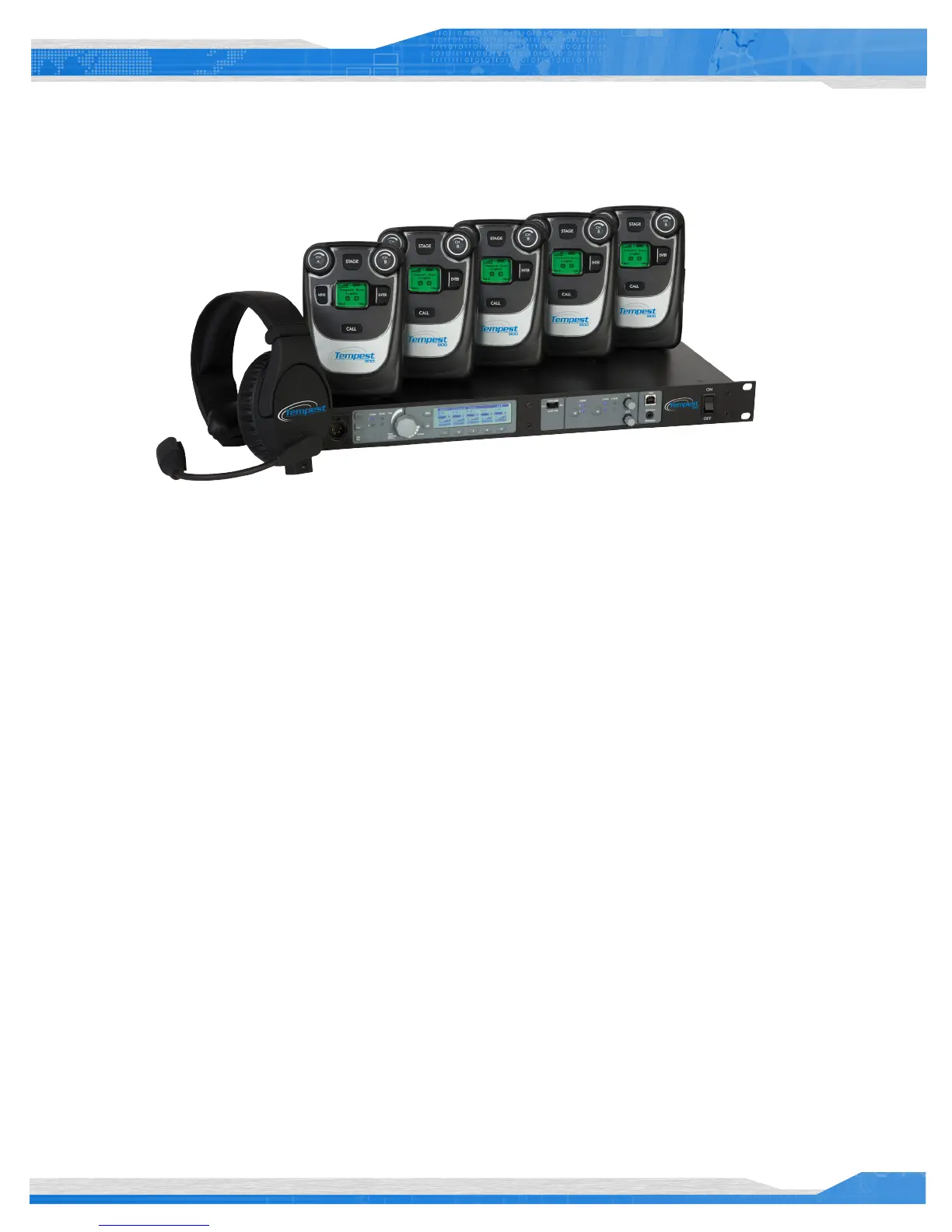
Tempest is a DSP (Digital Signal Processor) based, full duplex, wireless intercom system. It is a digital, point-to-point communications system,
operating in 26 MHz of spectrum in the 900MHz frequency band. This band allows users to operate with no license requirements in most
locations.
The 900MHz band offers many benets. There are, however, a wide variety of technologies and users competing for clear spectrum in this limited
band. Tempest utilizes patented and proprietary technologies to ensure a robust and reliable RF link under a wide variety of physical and RF
environments. This level of reliability is the most important attribute of any wireless system.
Tempest utilizes proprietary, Frequency Hopping Spread Spectrum (FHSS) technology that has seven U.S. patents. Multiple BeltStation access
is achieved by implementing Time Domain Multiple Access (TDMA) with Frequency Shift Keying (FSK) modulation. Tempest uses an Algebraic
Code - Excited Linear Prediction (A-CELP) voice compression algorithm to reduce the bandwidth necessary for transmission and yet maintain the
highest possible voice intelligibility. In addition, this algorithm utilizes advanced lost packet masking technology, which greatly reduces the affect
of packet loss, possible in all Digital RF transmission schemes. The loss of audio packets is managed by the algorithm to reduce the possibility of
detecting a loss of audio.
The incorporation of various diversity techniques provide an RF system that is robust and reliable under greatly varying operational conditions.
Because of this inherent design, Tempest delivers superior operational range and greater levels of interference and multi path fade rejection.
Covering extremely large areas or multiple coverage locations can be problematic with traditional wireless intercom systems. Tempest utilizes
iSelect™ on-command roaming to allow users to move from one area of coverage to another. iSelect allows Tempest users to easily choose
the desired coverage area by selecting the BaseStation they want to communicate through. The BeltStation (remote) remembers the last 64
BaseStations with which it has been Paired. When a different BaseStation is selected, the hopping pattern and key code of the BeltStation is
synchronized to the selected BaseStation and the BeltStation logs into the BaseStation.
Audio latency is a critical factor in all digital systems. The hop duration in Tempest is intentionally kept very short - under
10ms. This short hop duration limits the amount of data that may be lost in any one hop. More importantly, it reduces system latency, which can
cause undesirable echo. Total one-way (BeltStation to BaseStation) system latency is less than 50ms.
Even with this short system latency, unwanted and distracting echo will occur when interfacing with hard wired party-line intercom systems
unless echo-reduction technology is implemented. Echo is primarily the result of inefciencies in the conversion of the two-wire signal. This
condition exists in analog systems as well, but it does not cause unwanted echo because there is no system latency delay. Tempest uses
advanced echo-cancellation algorithms to eliminate this echo.
Wireless intercom systems are often used in high-noise environments that require special design consideration for effective operation. Tempest
operates extremely well even in very high ambient noise levels. This is primarily due to specic design criteria which allow Tempest to achieve


 To Next Page