Chapter 3: Function Graphing 72
Shading Above and Below
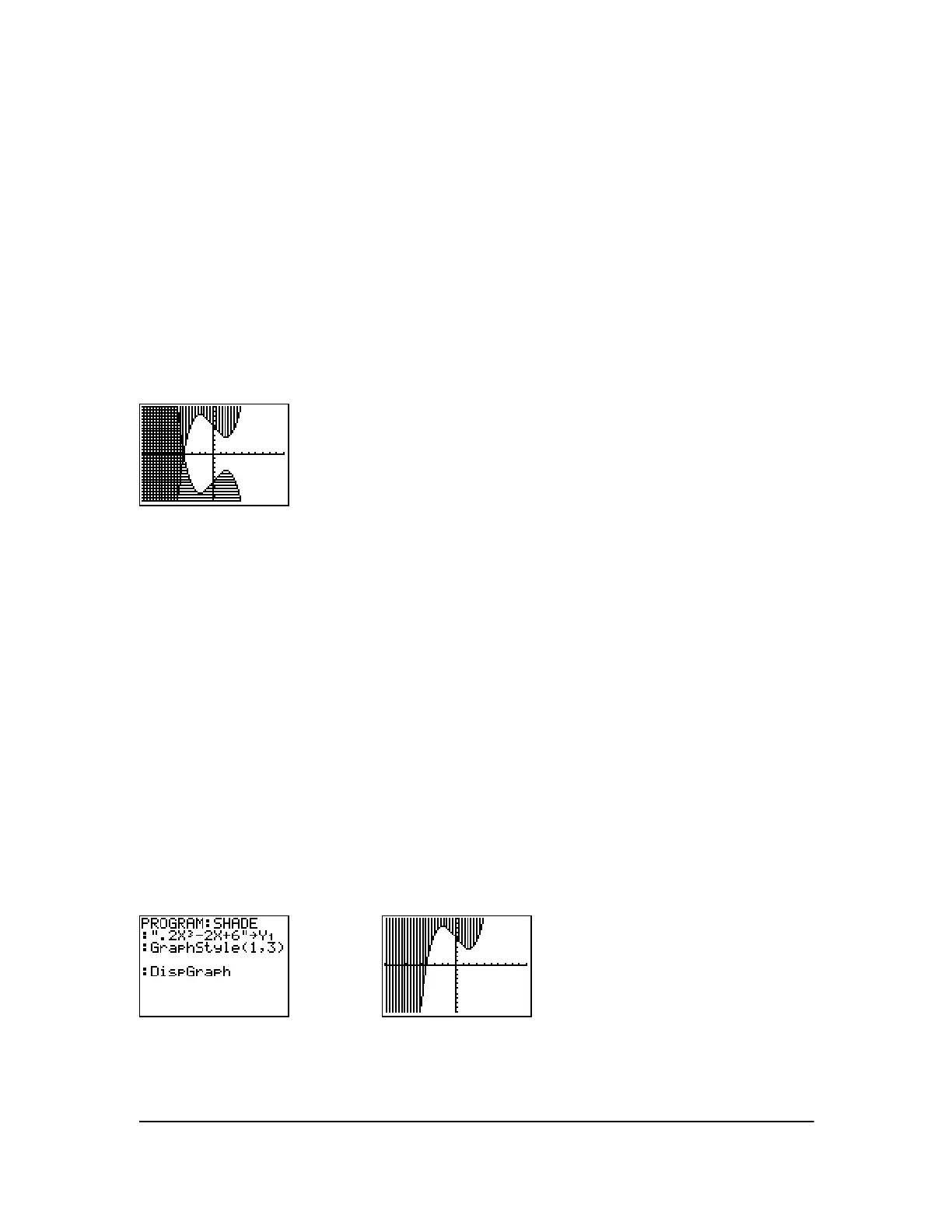
When you select é or ê for two or more functions, the TI-84 Plus rotates through four shading
patterns.
• Vertical lines shade the first function with a é or ê graph style.
• Horizontal lines shade the second.
• Negatively sloping diagonal lines shade the third.
• Positively sloping diagonal lines shade the fourth.
• The rotation returns to vertical lines for the fifth é or ê function, repeating the order described
above.
When shaded areas intersect, the patterns overlap.
Note: When é or ê is selected for a Y= function that graphs a family of curves, such as Y1={1,2,3}X,
the four shading patterns rotate for each member of the family of curves.
Setting a Graph Style from a Program
To set the graph style from a program, select
H:GraphStyle( from the PRGM CTL menu. To display
this menu, press while in the program editor.
function# is the number of the Y= function name
in the current graphing mode.
graphstyle# is an integer from 1 to 7 that corresponds to the graph
style, as shown below.
GraphStyle(function#,graphstyle#)
For example, when this program is executed in Func mode, GraphStyle(1,3) sets Y1 to é (above).
1 = ç (line)
2 = è (thick)
3 = é (above)
4 = ê (below)
5
= ë (path)
6 = ì (animate)
7 = í (dot)


 To Next Page
 Loading...