B
4
Repair Manual
GENERAL INFORMATION AND ROUTINE MAINTENANCE
Read all of SAFETY and this section before attempting any procedure. Pay particular attention to Notices, Cautions, Warnings and Dangers.
10002660
7. Carefully remove the wheel chocks in the direction
that the vehicle needs to be moved.
8. Turn the key switch to the OFF position after the car
has been moved.
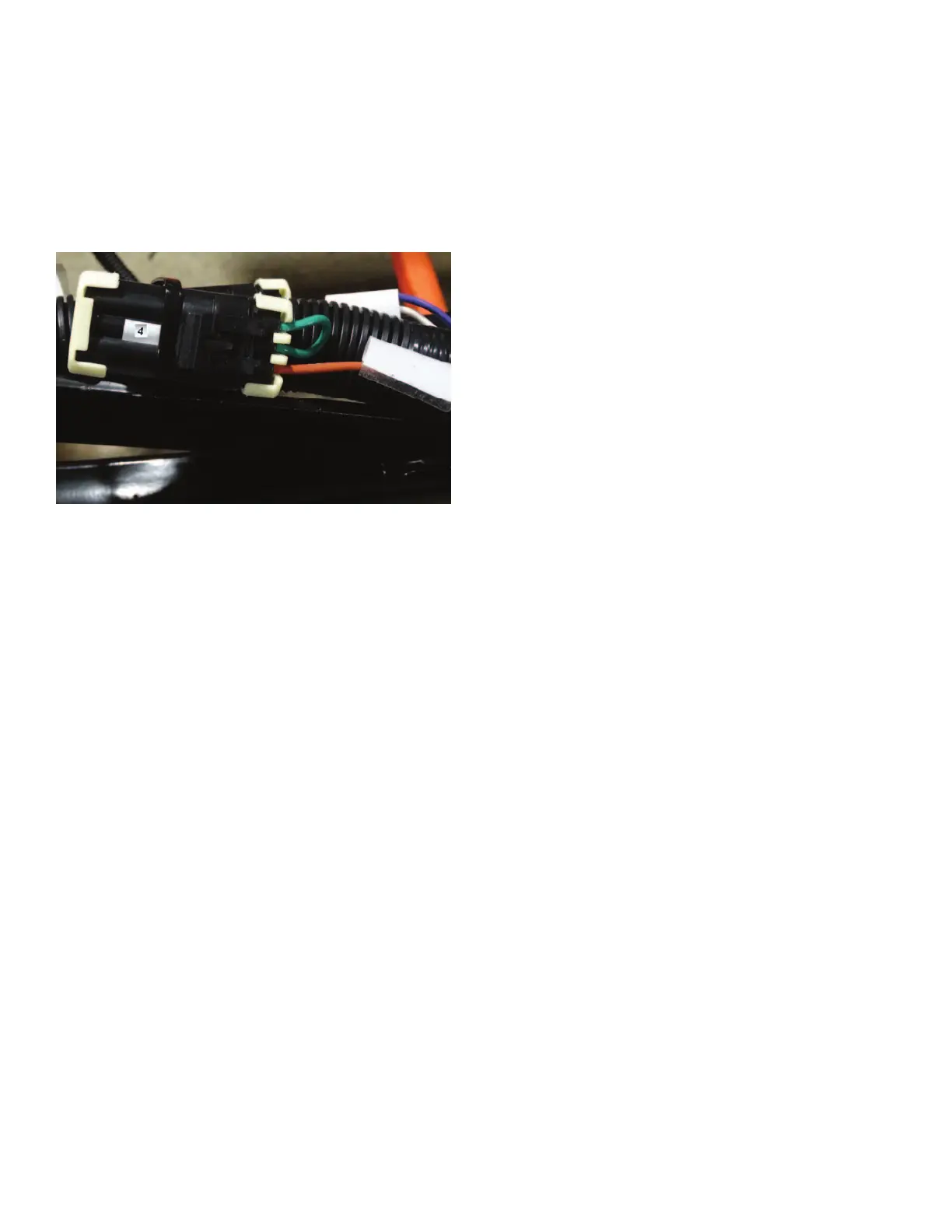
9. Disconnect both sets of connectors and connect 1 to
2 and 3 to 4. This will return the vehicle to normal
operation.
Fig. 5 Motor Brake Jumper
TOWING A TRAILER
The vehicle is equipped with a 2-inch receiver. The trailer
and its load must not exceed 1000 lbs (454 kg) and no
more than 100 lbs (46 kg) tongue weight can be attached
to the hitch. The overall capacity of the vehicle, operator,
passenger, and accessories must be reduced to compen-
sate for the trailer and load.
The range of motion of the trailer is limited by the ball and
hitch. The trailer should not be used on rough trails or
over objects such as logs, large rocks, holes, etc.
Never install baskets or extensions using the hitch receiv-
ers. Such items will change the performance characteris-
tics of vehicle and cause unsafe handling, possible roll
over, or vehicle damage.
PROLONGED STORAGE
During periods of storage, the batteries must be main-
tained to prevent discharge.
During cold conditions, the batteries must be fully
charged to prevent the possibility of freezing. A fully
charged battery will not freeze in temperatures above
-75° F (-60° C). Although the chemical reaction is slowed
in cold temperatures, the battery must be stored fully
charged, and disconnected from any circuit that could dis-
charge the battery.
Clean the batteries and neutralize all deposits on the bat-
tery cases to prevent self discharge.
The battery charger can remain connected to the vehicle
to maintain a full charge on the batteries provided the
charger is connected to an active electrical source. If
power to the electrical source is disconnected or inter-
rupted, the battery charger will continue to check the
charge on the battery pack. This will pull power from the
battery pack and eventually drain the batteries if power is
not restored in a timely manner.
HARDWARE
Periodically, inspect the vehicle for loose fasteners. Use
care when tightening fasteners, refer to the following table
for torque values (Ref. Fig. 6).
Three classes of standard hardware, and two classes of
metric hardware are used in the vehicle.
Standard:
• Grade 2 hardware is unmarked.
• Grade 5 hardware can be identified by the three
marks on the hex head.
• Grade 8 hardware is identified by six marks on the
head.
The class specification is marked on metric hardware.



 To Next Page